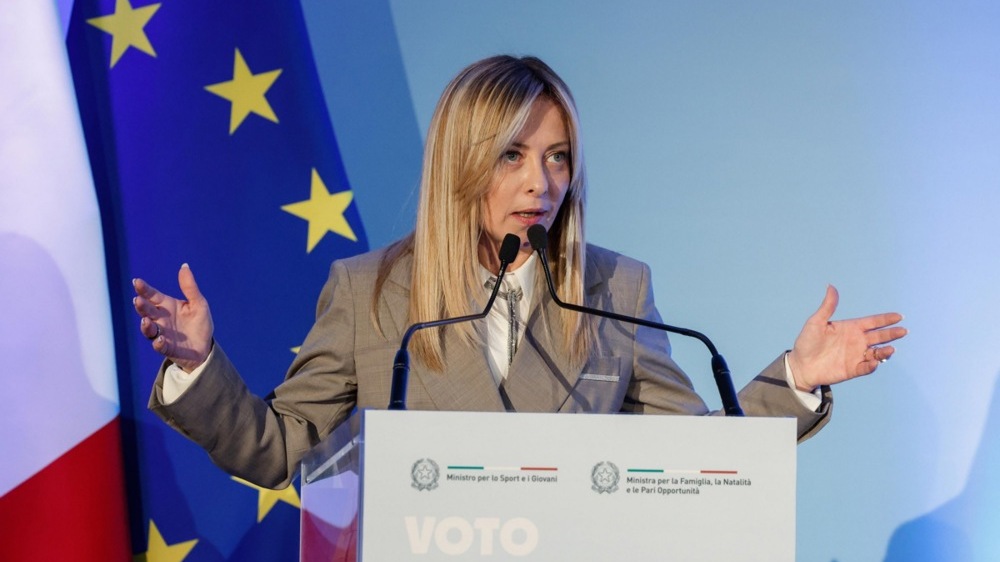
When the price of gas at the Dutch TTF hub soared above €60 per MWh in a matter of weeks — nearly double last year's levels — voices in several European capitals were again heard about the possibility of returning to Russian supplies. Rome responded with a refusal.
"It's too early" — but there is already a deadline
"I continue to hope that when the problem truly emerges — and that is January 2027 — we will be able to make progress on the question of peace in Ukraine," Prime Minister Giorgia Meloni told journalists in Verona, according to Bloomberg. She then added something that transforms the statement from diplomatic formula into strategic position: "We must not forget that economic pressure on Russia is, ultimately, the strongest weapon we have for building peace."
The context of this statement is not abstract. The Iranian war has effectively closed the Strait of Hormuz, through which approximately 20% of the world's gas and oil passes. European storage facilities, following the harsh winter of 2025–2026, are filled to only 30%. According to the Atlantic Council, Asian buyers are already outbidding Europe for American LNG tankers — competition that the Old World is losing on price.
What replaced the Russian pipeline
Before the full-scale invasion, Russia supplied approximately 40% of Italy's gas imports. By 2025, this share has essentially been reduced to zero. According to Italian Facts Energy analysts, Algeria through the Transmed pipeline now covers approximately 36% of supplies, Azerbaijan through TAP — another 15–16%. The remainder is obtained through LNG terminals — from the United States, Qatar, and North Africa.
In July 2025, ENI signed a 20-year contract with American Venture Global for supplying 2 million tons of LNG annually from a new terminal in Louisiana — part of what Decode39 analysts characterize as a "transatlantic energy corridor" to replace Moscow's.
"The Meloni government, unlike others, is betting on structural separation from Russian energy, concentrating on alternative deals with North Africa and transatlantic partners."
Decode39, analytical portal on Italian foreign policy
The price of independence — on the bills
Diversification costs literally. According to Eurostat data for the first half of 2025, Italy ranks fourth in the EU for household gas prices — 0.088 euros per kWh, above the EU and eurozone average. For comparison: before the full-scale war began, Rome paid significantly less for gas — precisely thanks to cheap long-term contracts with Gazprom.
That is, each Italian family is already paying for the country's geopolitical choice in utility bills. The question is whether it understands this — and whether it is willing to pay further if the crisis extends into the summer injection season.
A crack within the coalition
Meloni's position is not consensual even within her own government. Matteo Salvini's League party has already called for returning frozen Russian assets to Moscow. Foreign Minister Antonio Tajani reacted sharply: "The line is set by the prime minister — and I share it," Bloomberg reports. But the very fact of public disagreement within the coalition shows: social pressure through gas bills is transforming into political pressure.
Meanwhile, in August 2025, Meloni, together with Macron, Merz, Starmer, and other leaders, signed a joint EU statement: "We will continue to strengthen sanctions and broader economic measures to pressure Russia's war economy" — until a just peace is achieved.
Until January 2027 — or what?
Meloni has essentially named a date: if there is no peace in Ukraine by the start of the 2026–2027 heating season, Rome will face a choice between sanctions discipline and voter bills. At current prices and with the Strait of Hormuz closed, this arithmetic no longer looks abstract. If the EU does not open new supplies or the LNG market does not stabilize by autumn — the question of "whether to return or not" may arise in a completely different way than it did today in Verona.







