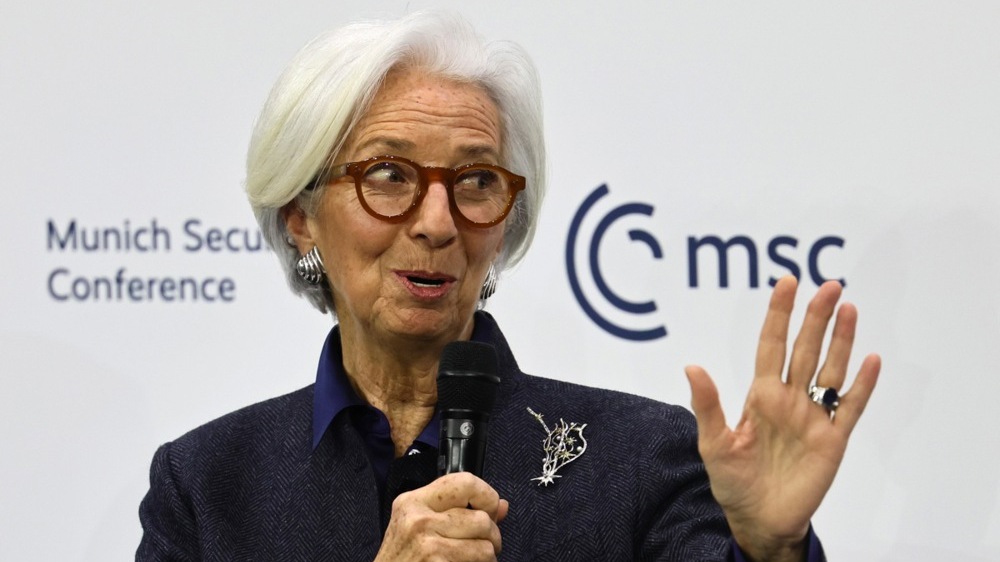
In April 2025, Klaus Schwab, founder of the World Economic Forum, told the Financial Times that he personally met with Christine Lagarde in Frankfurt and discussed with her the possibility of transitioning to the position of WEF chair — ahead of schedule, before her mandate at the ECB ends in October 2027. Lagarde's response came in two formats: first as a metaphor, then as plain text.
"When there are big clouds on the horizon, the captain does not leave the ship — and this captain is not going to leave the ship, because I see the clouds. When you see serious shocks, energy supply cuts, threats to growth and risks of accelerating inflation — these are serious matters that we must pay attention to."
— Christine Lagarde, interview with Bloomberg TV, Washington
At a press conference in Frankfurt, she was even more concise: "I am fully committed to fulfilling my mission and completing my term. I'm sorry to disappoint you — you won't get rid of me that quickly."
Why the resignation question arose at all
Schwab left the WEF ahead of schedule — in April 2025 — amid accusations of financial misconduct and conflict with the forum's board members (he himself denies any violations). According to Bloomberg, the WEF had been holding internal consultations about Lagarde as a successor even before his departure — the plan involved synchronization: Schwab leaves in 2027, Lagarde does the same, from the ECB. Schwab's unexpected resignation destroyed this scenario.
Additional context: Lagarde already has a precedent for early departure — in 2019 she left her position as head of the IMF, also denying interest in a new position in advance. According to bankingnews.gr, within the WEF, Lagarde is increasingly perceived as a "Schwab candidate" — which actually works against her in the current situation.
"Clouds" are not a metaphor, but specific figures
The interplay between personal drama and institutional matters lies in the fact that the economic background is indeed alarming. According to the ECB's assessment, 25 percent American tariffs on European goods reduce eurozone GDP by approximately 0.3 percentage points in the first year; if the EU responds symmetrically — by up to 0.5 pp. The baseline forecast for GDP growth in 2025 is only 0.9%.
At the IMF's spring meetings in Washington, Lagarde acknowledged: "The disinflation process is close to completion" — but warned that the impact of tariffs "will depend on what countermeasures Europe ultimately takes." The head of the Dutch Central Bank, Klaas Knot, was more direct: "In the short term — below growth and probably lower inflation."
ING's chief economist Carsten Brzeski, commenting on the question of Lagarde's successor, noted that Knot is "professionally qualified" for the position of ECB president — and markets seem to have already opened their own "betting pool" on the successor, regardless of official assurances.
What is really at stake
By staying until October 2027, Lagarde will lead the ECB through at least several more key rate decision cycles amid trade turbulence, possible recessionary pressure, and elections in key eurozone countries. Her mandate is non-renewable — meaning she has no incentive to play to the public for re-election.
If tariff pressure from the United States does not ease by the end of 2025, the ECB will face a dilemma with no "correct" answer: lower rates to support growth — and risk inflation, or hold firm — and intensify recessionary pressure. That's when it will become clear whether Lagarde is truly a "captain in a storm" — or just someone who failed to find a better ship.