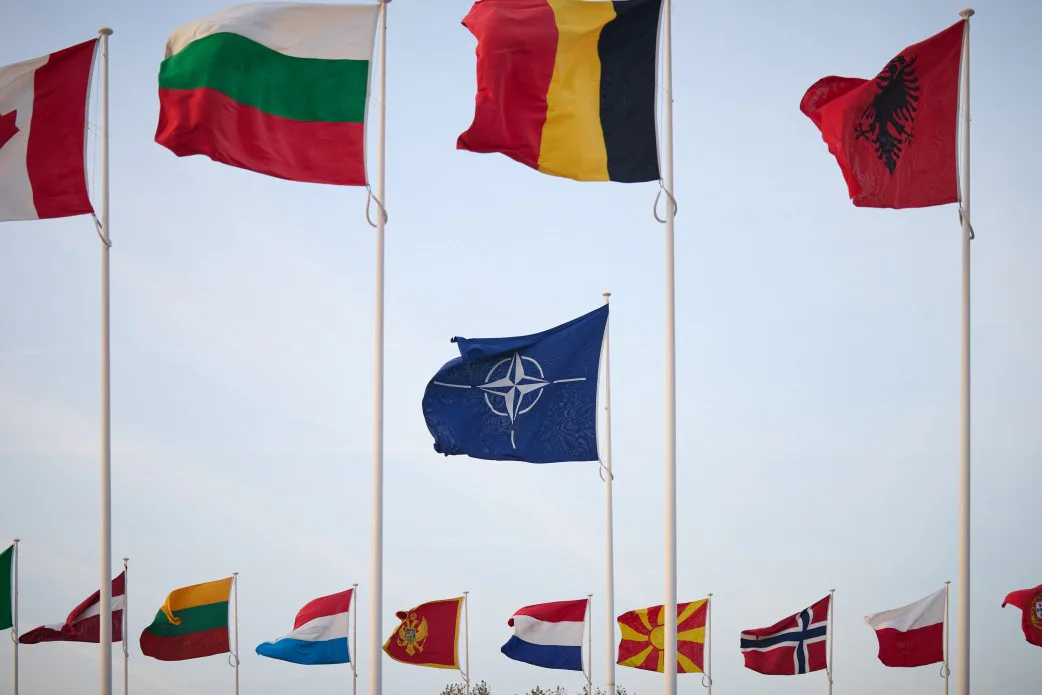
NATO countries are discussing a new commitment to finance Ukraine at €70 billion, which they plan to present at the Alliance summit in Ankara on July 7–8, Politico reports citing four NATO diplomats. The figure consists of two parts: €30 billion — credited from the already agreed two-year EU loan to Ukraine of €90 billion, and €40 billion — new bilateral contributions from member states.
Germany prepared the proposal. Besides the sum, Berlin insists on creating a transparency mechanism: to monitor who contributes what — and whether it is proportional to the size of their economy. This is a direct response to frustration among smaller allies, who believe they are bearing a disproportionately large burden.
Who is complaining and why
According to the Kiel Institute, since the start of the full-scale invasion, the United States has provided the most aid (€115.4 billion), followed by Germany (€25.3 billion), Great Britain (€20 billion), Canada (€13.97 billion), and France (€7.91 billion). But when calculated as a percentage of GDP, the picture is different: the Netherlands, Poland, the Baltic countries, and Scandinavian nations are already spending 0.25% of GDP or more to support Ukraine — while France, Spain, and Italy are falling significantly behind.
"Support for Ukraine is distributed unevenly across the Alliance — many members are spending insufficiently relative to their economic capabilities."
Mark Rutte, NATO Secretary General
This is why in May, Rutte proposed making 0.25% of GDP a mandatory annual contribution. According to NATO calculations, this would triple aid — to €143 billion per year. The initiative failed: Great Britain, France, Spain, Italy, and Canada blocked it. Rutte acknowledged that "the proposal will most likely not be submitted."
What does €70 billion mean in practice
For Ukraine, this amount is critical: in 2026, the need for external financing is approximately $50 billion just to cover civil budget items, while total defense spending is $65 billion per year, noted economist Oleg Ustenko. Meanwhile, the United States under the Trump administration has shifted from providing free weapons to selling them — meaning part of the €70 billion Kyiv receives will come not as a grant, but as debt.
The Kiel Institute notes: in the first half of 2025, new military aid allocations in Europe fell to the lowest level since 2022. "Disparities within Europe have deepened," the institute's analysts state. "Spain and Italy contributed very little."
EU Commissioner for Defense Andrius Kubilius emphasized that the EU is "unwavering" in supporting Ukraine — but in parallel stated that Kyiv's NATO membership is "currently unavailable" and proposed an alternative in the form of a European Defense Union. The position is telling: to support while simultaneously keeping out.
A mechanism without teeth?
The key question about the Ankara package is not the amount, but the architecture. The previous baseline of €40 billion, adopted at the 2024 Washington summit, was exceeded by allies: in 2024, over €50 billion was allocated. But this happened without mandatory quotas — simply the goodwill of those willing to pay.
Berlin's new "transparency mechanism" was supposed to fix precisely this gap. However, if five major economies in the Alliance have already blocked Rutte's stricter version, the question arises: will they now agree to a softer one, but with named schedules for contributions?
If France, Spain, and Italy sign the Ankara document with transparent distribution — and publicly commit to their shares — the mechanism will have real pressure. If they sign without figures against each country, €70 billion risks becoming yet another declaration of intent.