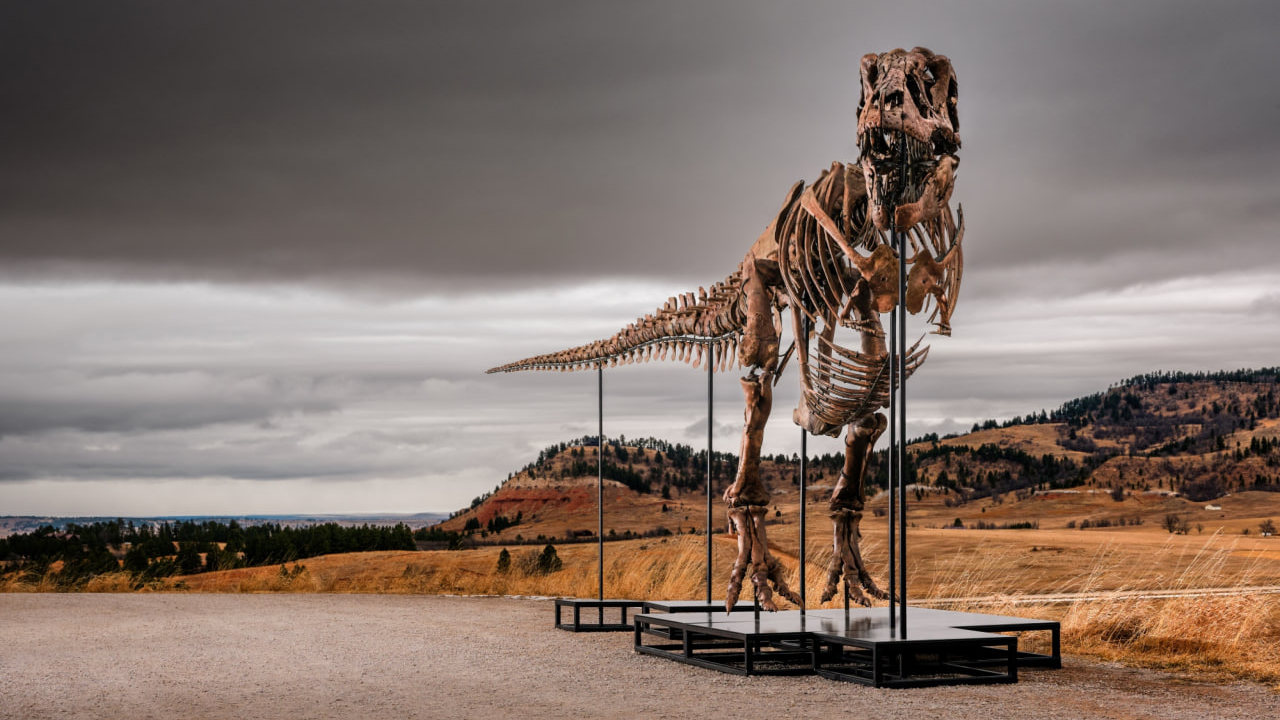
67 million years Gas lay in the rock of South Dakota. It took just 10 minutes to sell it. On Tuesday at Sotheby's auction, the skeleton of a Tyrannosaurus rex went under the hammer for $50.1 million — to an anonymous buyer who bid by phone and defeated six other contenders.
A record that broke a record that broke a record
Back in 2020, a T-Rex named Stan was sold for $31.8 million — and that seemed like the limit. In 2024, Sotheby's sold the skeleton of a stegosaur named Apex for $44.6 million to billionaire hedge fund manager Ken Griffin. Now Gas — $50.1 million against an initial estimate of $20–30 million. According to the auction house, this is the most expensive collection of fossil bones in auction history.
Gas is 11.6 meters long, 3.6 meters tall, with bite marks on its skull and several healed broken ribs. 61% of the bones are original — exceptional completeness for a T-Rex. Most museum tyrannosaurs contain casts from Stan's skeleton; Gas, according to CNN, has no such insertions and comes with "full rights" — meaning the buyer gains control over all casts and scans.
The USA is the only country where this is even possible
"The United States is the only country in the world where such fossils are considered private property. If you own the land, you own the fossil and have the right to sell it."
Cassandra Hatton, head of science and natural history at Sotheby's, AFP
Gas was found on private land in South Dakota. This is what made the sale legally impeccable — and scientifically problematic. As noted by Hone, a paleontologist at Queen Mary University of London, public institutions could excavate such specimens themselves if landowners allowed it. But the commercial incentive — and corresponding speed — are incomparably higher for private owners.
Why scientists are sounding the alarm
Richard Butler, a paleontologist at the University of Birmingham, called the trend "very alarming": fossils outside recognized museum collections effectively fall out of scientific circulation. Stephen Brusatte from the University of Edinburgh added bluntly: only the ultra-wealthy can pay such prices.
- Access to the original: anatomical analysis, new scanning methods, or genetic research require the actual bone — not a cast.
- Loan uncertainty: a private owner can withdraw a skeleton from a museum or resell it at any time.
- Price spiral: museums have long lost this market — and lose more ground each year.
Auction advocates appeal to pragmatism: commercial paleontologists spend their own money and time on excavations, without which Gas would simply crumble into the rock. As Hatton says, "if these fossils are not excavated, they will disappear."
The previous record holder, the stegosaur Apex, is now on long-term loan at the American Museum of Natural History in New York — the best scenario realized so far. But it depends entirely on the buyer's goodwill.
The identity of Gas's new owner remains unknown. If it ends up in a private collection with no public access, the next researcher who wants to study the bite marks on its skull will have to rely on a billionaire's kindness — or wait for the next auction.