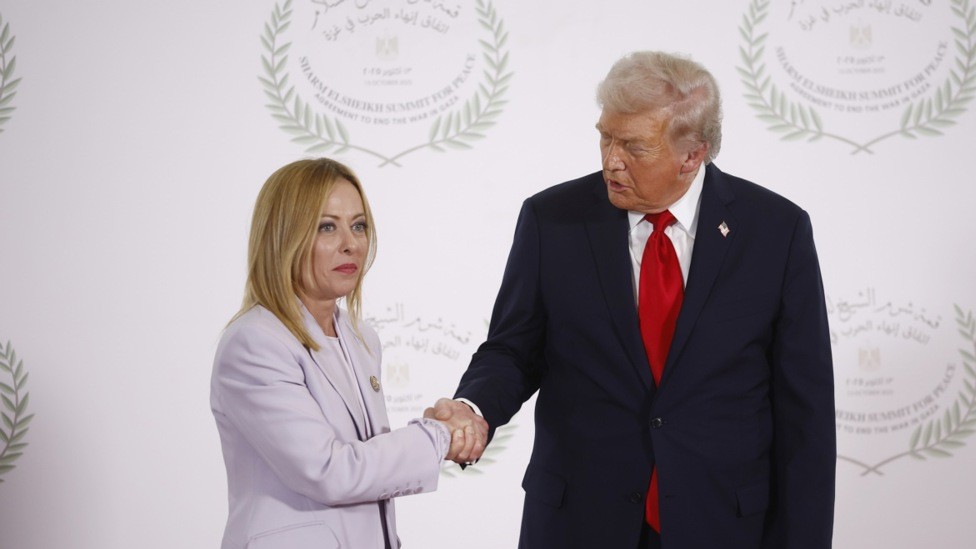
Four months ago, Donald Trump publicly called Giorgia Meloni a "wonderful woman" and "very strong leader." On April 14, 2026, in an interview with Corriere della Sera, he said something different: "I am shocked by her. I thought she had courage. I was mistaken."
The reason is twofold. First, Meloni refused to send Italian minesweepers to open the Strait of Hormuz, which the US is trying to unblock after Iran has effectively closed it to shipping. Second, the Prime Minister called "unacceptable" Trump's words about Pope Leo XIV — the American pontiff whom the president publicly criticized for disagreeing with the Iranian war.
What lies behind talk of "courage"
Trump explained the logic of his displeasure directly in that same interview: "They depend on Donald Trump to keep the strait open. They pay the highest energy prices in the world — and are not even willing to fight for it." According to the president, he asked Rome to send "anything they want" — but received a refusal.
"She is no longer the same person, and Italy will not be the same country."
Donald Trump, Corriere della Sera, April 14, 2026
Meloni responded: "Unacceptable — that is him." However, public rhetoric is secondary. Primary is the price of a megawatt-hour.
How much a closed strait costs
About 20% of the world's oil and liquefied gas passes through Hormuz. Since March 2026, when the strait was effectively blocked, the European Commission estimated gas price increases in the EU at 70%, oil at 50%. The additional bill for fossil fuel imports is €13 billion for the EU as a whole alone.
For Italy, the figures are more painful than for France or Spain. As warns the analytical center ECCO, which specializes in climate and energy, the increase in energy costs is capable of raising inflation in Italy by 1–1.5 percentage points solely due to the Iranian conflict. The Bank of Italy describes the current situation as "exceptionally high uncertainty." The head of the IEA Fatih Birol called this crisis "the worst energy shock in history" a week earlier — more serious than the oil crises of the 1970s and the consequences of Russia's invasion of Ukraine combined.
The ECB in its March forecasts revised eurozone growth from 1.3% to below 1% in 2026, warning of stagflation risk in case of prolonged conflict. The OECD cut its forecast for Italy to 0.4% — the lowest among the bloc's major economies.
The domestic price of foreign friendship
The Trump-Meloni rift occurs against an unfavorable domestic backdrop for the Prime Minister. In late March, she lost a referendum on judicial reform — her first serious defeat since coming to power. Analysts from the European Council on Foreign Relations (ECFR) directly link this defeat to two factors: rising fuel prices and association with Trump, whose unpopularity in Italy is hitting records.
- The share of Italians with a positive view of Trump fell from 35% to 19% since the beginning of the Iranian conflict.
- Among voters aged 18–34, 61% voted against Meloni's reform.
- Deputy Prime Minister Matteo Salvini — another former MAGA sympathizer — publicly distanced himself from Trump after his attack on the Pope.
Meloni was the only European leader at Trump's inauguration in 2025 and counted on converting proximity to the White House into domestic political capital. Instead, as ECFR analysts note, "the Iranian attack showed: Rome is a peripheral player in Washington's strategic decisions."
Now, trying to compensate for losses from Hormuz, Meloni urgently flew to Algeria for negotiations on alternative gas supplies — steps that underscore how vulnerable the bet on American security guarantees proved instead of diversification.
The logic of the ultimatum
Trump repeated in that same interview a thesis he is broadcasting to all of Europe: countries that receive security and access to sea lanes from the US are obligated to participate in their defense militarily. "I asked them to send anything they want. But they don't want to," he said about the request for minesweepers.
Capital Economics warns in its analytical note: the American blockade "risks creating new potential flashpoints" in the conflict. Daniel Yergin, vice-chairman of S&P Global, characterized the situation more succinctly: "Nothing of this scale has ever happened."
If the strait remains blocked until the end of summer, and gas prices hold near €50–60 per MWh, questions to Meloni will come not from Trump, but from industrialists in Lombardy and Veneto — regions where steel and chemical producers have already factored 30-percent premiums into their accounts due to energy costs: was the bet on friendship with Washington a strategy — or simply a risky gamble?





