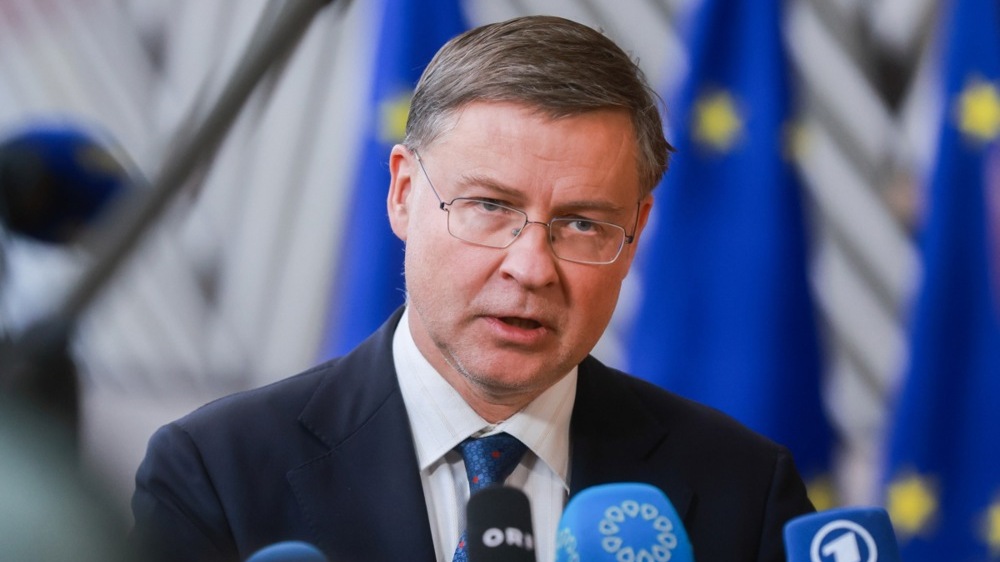
European Commission Vice-President Valdis Dombrovskis signed a Memorandum of Understanding on macro-financial assistance to Ukraine — the first instrument through which funds from the EU's new €90 billion credit will begin to flow. Ukraine's Minister of Finance Sergii Marchenko and National Bank of Ukraine Governor Andriy Pyshny signed the memorandum on the Ukrainian side.
What and when will arrive
Of the total €90 billion, Ukraine will receive €45 billion in 2026 — with only €16.7 billion of that as budget support. This portion is divided between two instruments: macro-financial assistance (MFA) and the Ukraine Facility program — €8.35 billion each.
According to Yevropeyska Pravda, MFA will be paid in three tranches: the first — €3.2 billion — no later than June, the second — €3.7 billion — approximately by late summer. The remainder of budget support (through Ukraine Facility) is tied to implementation of reforms under the so-called "10-point list."
Separately, there is a military component: €28.3 billion for 2026 with no conditions attached. The first tranche — €6 billion — is also expected no later than June and will go toward purchasing Ukrainian drones.
"We are preparing to make the first payment in June. This support and related reforms will strengthen the economy, promote government revenue growth, and support anti-corruption efforts. Now the Ukrainian parliament must approve these reforms."
Valdis Dombrovskis, European Commission Vice-President for Economics
The main obstacle — a tax that parliament has already rejected
According to Bloomberg, part of the EU credit payments are tied to introducing 20% VAT on international parcels for companies with annual turnover exceeding 4 million hryvnias (~€78,000). The IMF imposes the same requirement as a condition for allocating its $8.1 billion program.
The problem is that bill No. 14025, which contained these changes, was rejected by the Verkhovna Rada in March — it lacked sufficient votes. According to UNIAN citing sources, the situation regarding parliamentary support for the document remains at an "impasse."
Bloomberg notes: even if Kyiv buys time now, avoiding this reform is impossible — it is a mandatory condition for EU accession. The IMF and EU have already agreed to postpone another sensitive change — expanding the circle of VAT payers among Ukrainian businesses — but they insist on passing the "parcel" law by June.
Who will pay the debt
The credit structure is unusual: Ukraine is obliged to repay it only if it receives reparations from Russia. If there are no reparations — the debt will be covered by 24 EU member states that signed the loan. Czechia, Hungary, and Slovakia have withdrawn from the mechanism.
Economist Oleh Ustenko draws attention to the hidden cost of the deal: even a modest increase in interest rates — of 0.5% — on €90 billion over a 10-year period generates an additional $5 billion in servicing costs. "That's already very serious money," he noted.
If the Verkhovna Rada does not ratify the memorandum and does not pass the necessary bills by the end of May — the first tranche in June becomes a question, not a schedule: will the government find a parliamentary majority for the reform it already rejected once?