On the Name of the Irpin River
"All we know is but a drop in the vast ocean of the unknown." These words are believed to belong to Isaac Newton. But this ocean of the unknown is not somewhere far away. It begins here, right beside us.
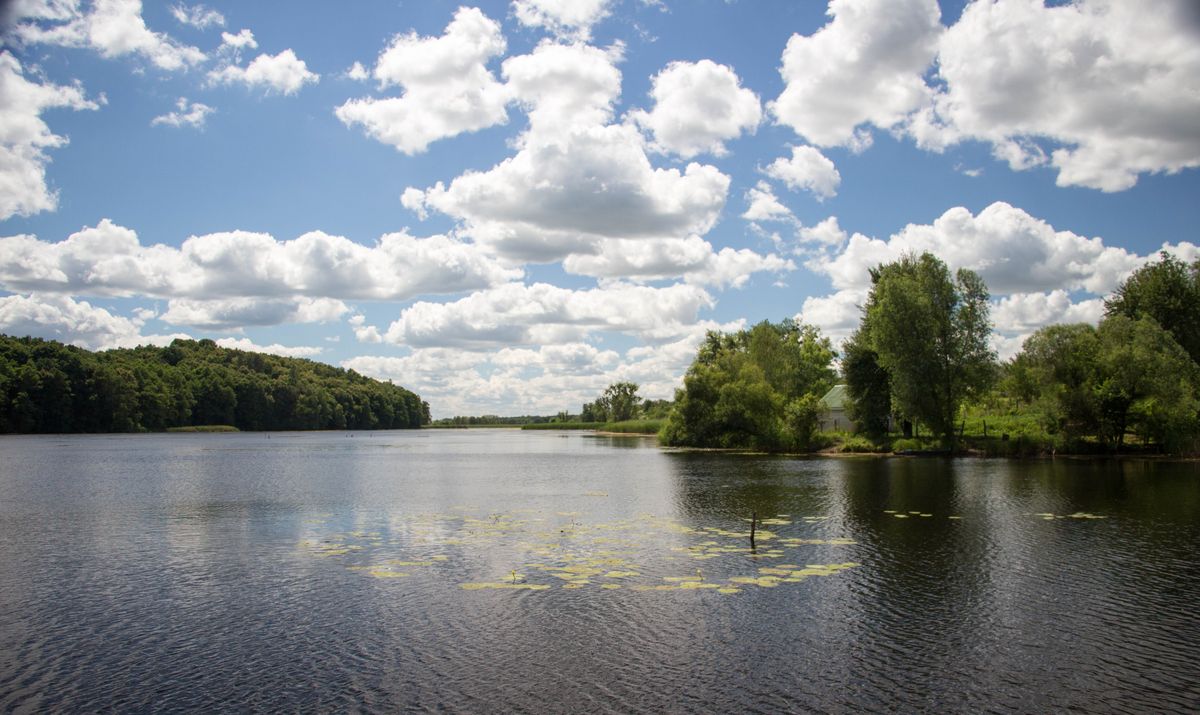
The Irpin River flows through the western outskirts of Kyiv. This name is well known in Ukraine. Recently, after the start of the full-scale invasion by the Muscovites, it has echoed around the world. But what does this name mean? What is this strange word—"Irpin"?
In general, the names of rivers and lakes, or hydronyms, are often very ancient. The meaning of these names is sometimes impossible to establish—because the peoples who once lived on those banks have long since vanished. Yet the name remains.
There are several versions of the origin of the name of the Irpin River, but none of them can be considered satisfactory.
Slavic РЪPЕНЬ, РЪП—"pit"
In fact, the Irpin has fairly deep places. But overall, this river does not resemble a pit. Moreover, in ancient times, people had mythological consciousness. Their lives directly depended on rivers. They loved their rivers and gave them more dignified names. So, not "pit."
Polish Version: RUPA—"a pit filled with water"
The same root base. Yes, after the division of Ukraine between Poland and Muscovy, the Irpin ran along the border. But the name Irpin is mentioned in much older sources. Besides, purely Polish hydronyms in Ukraine are practically non-existent. And again, the Irpin does not resemble a pit filled with water.
Mythological Version: "Pirna" (from the god Perun)
Perun is a god associated with the sky, storms, and later—war and warriors. It is unlikely that a small river would be named after him. And in general, we have no rivers named after Rod, Svarog, Triglaw, Radogast, Dazhbog, and others. They did not do such things.
Foreign Versions
Old English: "Ierfen"—"marshy land"
There is no reliable evidence that ancient Angles ever lived in the Kyiv region, although there are such conjectures. But it should be noted: the Irpin in ancient times was not "marshy land." The groundwater level in the Irpin valley was much lower and rose only after the construction of the Kyiv Hydroelectric Station dam.
Tatar Version: thistle, bur-marigold in Tatar—"irpa"
Naming a river after a plant is a fairly rare practice. Also, to pass on to descendants the name of a river, one must live on its banks for a very long time, for generations. And Tatars appeared near the Irpin only episodically.
We Need to Dig Deeper
Apparently, the name "Irpin" is very old and comes from some ancient language, now lost. What peoples could have lived on the banks of the Irpin, say, 25–30 centuries ago? What language did they speak?
The Kyiv region belongs to the proto-Indo-European linguistic area. There are no written monuments from that time. But one can search for traces of proto-Indo-European names in other historical conditions and places where this linguistic heritage was successfully recorded.
Among the direct descendants of ancient Indo-Europeans is the tribe of "Hirpini." According to Hirpini legend, this people in ancient times migrated to southern Italy from the distant north. A tribal totem led them along this long path—a wolf, in the Hirpini language—"hirp" (hirp). We know of this from Roman sources.
"Hirp" is a very ancient proto-Indo-European word. It is quite possible that this is the key to solving the mystery of the name "Irpin." On Persian, by the way, "wolf" is garg, and in it the echo of the word "hirp" is quite noticeable—since Persian, or the Persian language, has a direct connection with proto-Indo-European, or Indo-Iranian, roots.
So, it is quite likely that the name "Irpin" comes from the proto-Indo-European root "hirp," meaning "wolf." By the way, "wolf" hydronyms are quite common in Ukraine and the world.
Thus, when studying one's region, one must dig deeper and ask more questions. Although this applies not only to local history research.
On Just War
It would seem that the topic of "just war" is self-evident and requires no deeper thought and discussion. Because, seemingly, everyone understands what justice is and what war is. But life has shown that any aggression can be presented as "just."
In reality, the art of war and the art of justifying war have always developed along parallel paths.
In Ancient Egypt, the justness of war was determined by three factors: Egypt's cosmological role, the pharaoh's person as the executor of the gods' will, and Egyptian state superiority over all other states and peoples. In Moscow's propaganda in our time, we see the same stories: about Russia's "god-chosen" role in the world, about the outstanding person of the lifelong ruler, and Moscow's sacred right to decide the fate of other nations. With these pseudo-sacred lies, the Muscovites have actually invented nothing new.
India
In ancient India, a significantly more progressive concept was developed—"Dharma-yuddha," or "just war." Military ethics criteria were formulated. For example, one cannot attack people in dire circumstances, one cannot use poisoned arrows, one cannot attack out of mere anger without a just cause, and fair treatment of prisoners and the wounded is required.
All this sounds quite contemporary. But, as we see, the Muscovites have not read the Mahabharata and dharma-yuddha is completely unknown to them.
China
Chinese philosophy created a vast body of works on war. War was justified only as a last resort and only if a legitimate ruler existed; however, to doubt the emperor's decision on the necessity of military action was impermissible.
The success of a military campaign was sufficient proof that the campaign was righteous. In other words, they came and took, by the just right of the strong. Does this remind you of anything?
Classical Europe
According to Aristotle, just war is one that allows for self-defense and the establishment of peace: "The true purpose of military training is not to enslave others, but to avoid enslavement oneself." Ideas about the justness of war as a last resort for restoring justice and civilized treatment of the defeated are the heritage of ancient Hellas.
The Romans of the republican period, though constantly at war, saw serious risk in the gods turning away if this was not bellum iustum ("just war"). They also used the concept of ius gentium, that is, "right of peoples"—a universal and equal right of every people to peaceful existence.
Of course, Rome in the imperial period no longer paid attention to such trifles as the "right of peoples." What, then, people who seriously believe their capital is the "third Rome" naturally have no idea about ius gentium.
The Christian World
Augustine the Blessed belongs an important discourse on the idea that peacefulness in the face of grave harm that can only be stopped by violence is a grave sin. Some present-day "pacifists" should be reminded of this, as they clearly have not read Augustine.
Also in Europe, based on Christian doctrine, understanding of two fundamental concepts of war ethics developed: jus ad bellum (justice of war, that is, circumstances under which wars can be justly waged) and jus in bello (justice in war, or moral considerations that should limit the use of violence in war).
The Muscovites, who for some reason call themselves Christians, are unaware of such things.
And Thomas Aquinas concluded that just war could be offensive, and that injustice should not be tolerated merely to avoid war.
Renaissance, Humanism, "Enlightenment," Modern Times
The understanding of just war, painfully earned by medieval Europe, gradually eroded in later times. It was precisely during the Renaissance that the first sprouts of pacifism appeared and ideas were propagated like "unjust peace is better than the most just war," with quotations torn from historical context attributed to Cicero.
And in general, tearing from historical context is a favorite polemical device of Enlightenment thinkers. This device is still loved by the media, thoughtlessly citing authoritative sources of the past. "End such great evil and achieve peaceful settlement, regardless of result and conditions"—a famous quote from William, Bishop of Tyre (12th century)—is not a universal "pacifist" call to stop any war, but a response to a very specific war waged by the Crusaders in the Middle East at that time.
The very idea of "justice of war" began to be rejected by some prominent thinkers. For example, Erasmus of Rotterdam criticized the theory of just war as a "smoke screen" for justifying aggression.
World thought still oscillates in one-dimensional space: from unrealistic and pacifist rejection of the very idea that war can be justified, necessary and inevitable—all the way to demagogic invention of mythical "causes of war" by Kremlin militarists, who operate with geopolitical concepts of the last century and see no limits to their aggression.
Contemporary Catholic Doctrine
The Catholic Church's doctrine of just war rests on the legacy of the most outstanding thinkers of the past. Therefore, the Vatican's policy regarding Russia's war against Ukraine has caused and causes certain misunderstanding and disappointment. For this doctrine allows the Church to clearly classify Russia's war against Ukraine as unlawful and unjust, and to point to the guilty party.
A thought aloud: perhaps it would be worth reminding the Vatican of its own documents, which should guide it.
How can we not mention Pope John Paul II, who once in an address to a group of soldiers noted the following: "Peace is more than simply the absence of war. The cause of peace will not advance if we deny the obligation to defend it."
This is precisely what Ukraine is doing now: advancing the cause of peace by defending it in war.
The UN
Despite legitimate criticism of its inaction and general ineffectiveness, the UN managed, at least declaratively, to fix important principles of inviolability of borders, territorial integrity, sovereignty—all of which Russia grossly and systematically violates.
The Charter of the United Nations is based on a general prohibition on the use of force to resolve disputes between states, except for two cases: lawful self-defense and measures taken by the Security Council in the exercise of its duties to maintain peace. In each case, the exercise of the right to self-defense must observe "the traditional limits of necessity and proportionality."
Just Post-War Settlement
In recent years, theorists such as Gary Bass, Luis Yelello, and Brian Orend have proposed expanding the understanding of "just war," which consisted of two concepts: jus ad bellum (justice of war, that is, circumstances under which wars can be justly waged) and jus in bello (justice in war, or moral considerations that should limit the use of violence in war). They proposed a third category within the theory of just war: jus post bellum ("just post-war settlement") as a new category of international law currently in development.
Jus post bellum concerns justice after war, including peace treaties, reconstruction, environmental restoration, trials for war crimes, and war reparations.
The idea of jus in bello is also being rethought. If previously it was believed that military personnel who did not violate the laws and customs of war were automatically absolved of individual responsibility for participation in a generally unjust war, now there is growing understanding that such soldiers also bear moral responsibility for their participation in such an act of aggression, even if they did not directly commit war crimes.
Actual guilt lies with the aggressor, and by being an aggressor, they lose their right to decent treatment through their actions.
We see that Moscow today is infinitely far from understanding the concepts of jus ad bellum, jus in bello, and jus post bellum. In terms of understanding the very idea of just war, the Muscovites have not come far from the times of early slaveholding eastern despotisms like Ancient Egypt or the "warring states" of ancient China. And so, jus post bellum looks even more difficult for them.
Snake Ramparts—A Mystery of Pre-Literary History of Ukraine-Rus
On the territory of Ukraine lies a mysterious monument of antiquity—the Snake Ramparts. This is an enormous complex of earthen structures. Their total length is approximately 950 kilometers (according to other data—up to 2000 kilometers). They are united in nine defensive lines. As a result of economic activity over many centuries, they have been largely destroyed. But they still amaze with the scale of earthwork that has no parallel in the world, and retain many secrets.
Near Bilohorodka, a section of the system of ramparts known as the Vityansk-Bobrinsk line of ramparts runs. These ramparts still reach 15 meters in height. They represent capital structures—earthen embankments, at the base of which are log frames made of thick wooden logs, serving as a supporting framework along the entire length. Apparently, there were also defensive wooden walls on the ramparts. The entire structure at the time of construction resembled a fragment of the defensive rampart of Kyiv, which was reconstructed when the Golden Gate was restored in the 1980s. In front of the ramparts was a ditch several meters deep, from which earth was apparently extracted for construction.
Questions Without Answers
During excavations near the ramparts, fragments of ceramics and even a princely-era ax were found. But despite these finds and some similarity of construction to known fortifications from the Rus period, there are certain circumstances that suggest the Snake Ramparts may be much older.
Why in chronicles are these ramparts mentioned only in the context of various events that occurred near them, but there is no mention of who and when built them? After all, work of such colossal scale could not have escaped the attention of chroniclers. That is, by the princely period, the ramparts already existed.
All we know about fortifications of the Rus period are the fortifications of individual settlements, citadels. The scale of work compared to the Snake Ramparts is simply incommensurate. The Snake Ramparts are enormous. They stretch for tens of kilometers, often parallel to each other and form an entire labyrinth over a large area—it is unlikely that such large-scale construction was within the power of ancient Rus people.
Radiocarbon analysis of the remains of wooden frame logs was performed in the early 1970s at the initiative of the famous rampart researcher, Arkadiy Silvesterovych Buhai. The analysis showed dating to the 2nd–7th centuries CE. This dating may point to the Gothic period, when a large and powerful early feudal state of the Goths existed in the Dnieper region, which they called Oium (in Gothic—land of rivers, or waters). Or to the proto-Slavic union of the Antes (Penkov culture)—although we know nothing of such large-scale construction in that period.
Some researchers believe that the construction of the ramparts was begun by the Scythians in antiquity, but there is no reliable evidence for this—although the rampart system partially uses ancient ramparts of Scythian-era settlements.
Legends, Conjectures, Facts
According to legends, once there was a terrible serpent that gave people no peace until a strong man, Mykyta Kozhumyak (in another version—Saints Cosmas and Damian), defeated the serpent and harnessed it to plow huge furrows with a plow. And the earth from the plowshare