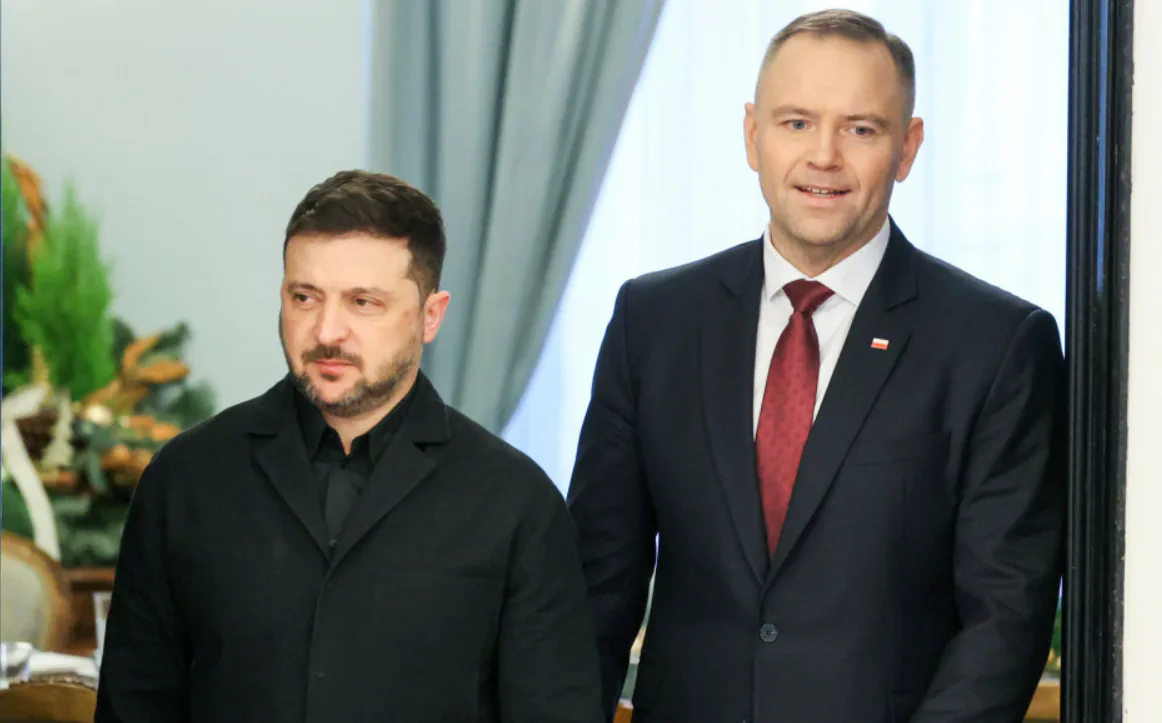
When on June 19, Polish President Karol Nawrocki stripped Volodymyr Zelenskyy of the Order of the White Eagle, most Polish media focused on the symbolic dimension of the scandal. New CBOS data reveals a more complex picture.
What the survey showed
59% of Poles supported Nawrocki's decision — against 28% who disagreed. But that's where the simple interpretation ends. 75% of respondents believe that Poland and Ukraine should primarily cooperate in the face of the Russian threat. And 73% are convinced that politicians from both countries are fueling conflicts for their own political gain.
In other words, the majority of Poles simultaneously approve of the specific gesture and deny politicians good-faith motives. This is not a contradiction — it is distrust of elites while maintaining one's own position on the event.
"The conflict between Poland and Ukraine pleases Putin and shocks our allies"
Polish Prime Minister Donald Tusk, after Nawrocki's decision
How this became possible
The formal pretext — Zelenskyy's decree of May 27 naming the Separate Special Operations Center "North" after the "Heroes of the UPA." Nawrocki announced his intention to strip the order the next day. But according to an investigation by Polish outlet Espreso, the idea emerged earlier — in pro-Russian and radically anti-Ukrainian circles of Polish internet, and on May 28, "Confederation" deputy Grzegorz Płaczek officially appealed to the president with the corresponding request.
Nawrocki used the request prepared for him by opponents of the Euro-Atlantic course. The result proved electorally advantageous: according to IBRiS, his trust rating jumped by 8.4 percentage points — to a record 54.8%.
The price of the gesture
Zelenskyy returned the order through the Polish ambassador. Subsequently, three former presidents of Ukraine — also refused Polish decorations. Prime Minister Tusk called the dispute a potential strategic mistake with negative consequences for business: Poland is competing for a significant share of Ukraine's reconstruction contracts.
- Polish opinions on the consequences of the decision for the country split evenly: 41% each believe that Poland won or lost from this step.
- Tusk and Nawrocki are in open conflict — the president is acting against the government's position, which is constitutionally normal for Poland, but diplomatically destructive in wartime.
- The real beneficiary of the situation — Moscow, which systematically uses Polish-Ukrainian historical memory as a wedge in relations between the two countries.
The gap between emotion and strategy
CBOS data records a classic phenomenon: people can simultaneously approve of an action and realize that it is counterproductive. 73% of Poles who believe that politicians are deliberately escalating the situation — this is not a minority of skeptics. This is the majority that votes for the decision but does not believe in its motives.
If Warsaw and Kyiv do not establish a common mechanism to resolve disputes over historical memory before the next negotiations on Ukraine's EU membership, similar crises will repeat themselves every time some Polish politician needs to boost their ratings.







