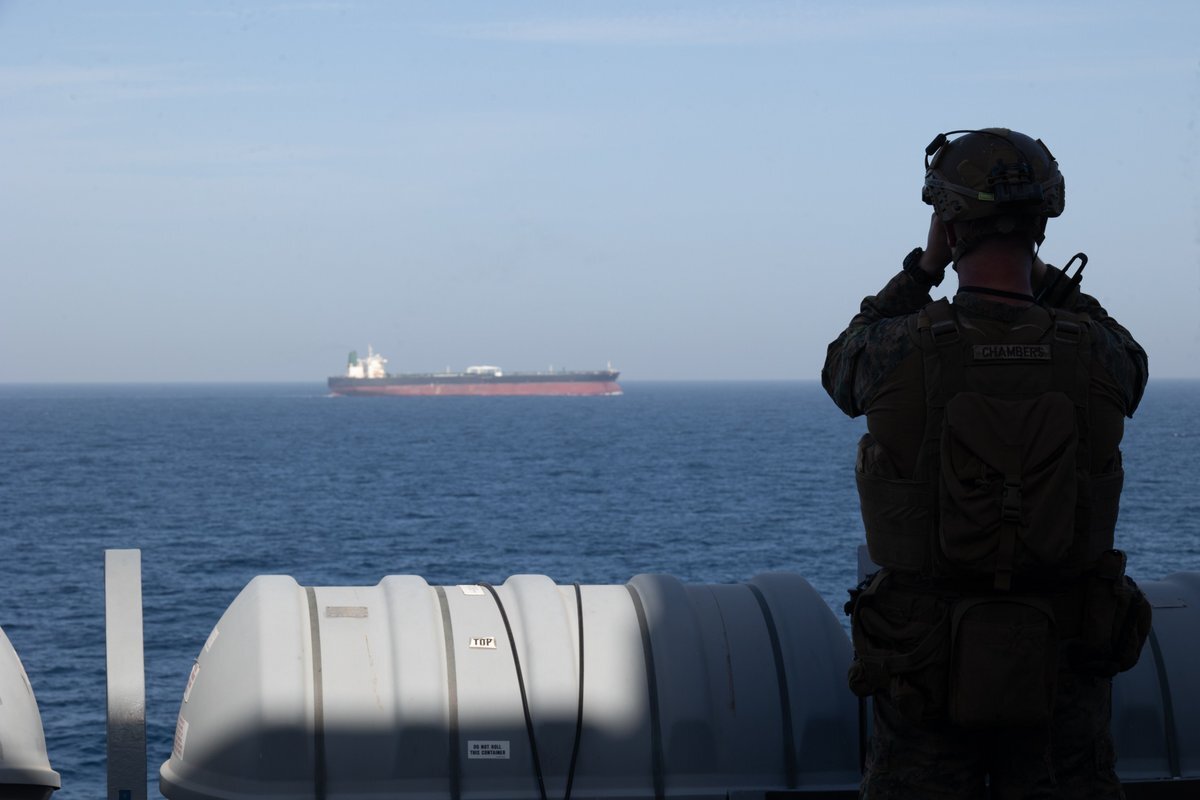
American military forces are preparing in the coming days to board and seize oil tankers and commercial vessels linked to Iran in international waters. According to The Wall Street Journal citing American officials, the operation is not limited to the Middle East — the geography is deliberately obscured.
The scheme: shadow fleet, flag, and jurisdiction
Iran's "shadow fleet" is not individual vessels, but, as the Kharon analytical center explains, "a shared ecosystem of sanctions-evasion services," where the same vessel can have multiple owners, several flags, and no real jurisdiction. According to Kharon, over 70% of sanctioned tankers changed flags at least once during 2025 — to conceal ownership and complicate confiscation.
This scheme gives the United States the legal basis for action. As USNI News explains, citing two former chief legal officers of the Coast Guard, the key mechanism is the UN Convention on the Law of the Sea (UNCLOS): if a vessel claims two nationalities or sails under a fictitious flag whose registering country denies registration, it is considered "stateless" — and falls under American jurisdiction.
"They claimed two nationalities — so they have no protection whatsoever."
Former Chief Legal Officer of the U.S. Coast Guard Baumgartner — USNI News
The irony: the United States itself has not ratified UNCLOS, but relies on its provisions to legalize seizures on the high seas.
What has already happened: from the Caribbean to the Indian Ocean
The operation is not an announcement — it has been unfolding since December 2025. The first seized tanker was MT Skipper, arrested on December 10, 2025, near Venezuela: Guyana confirmed that the registration was fictitious. In January 2026, the Coast Guard seized MT Olina (January 9) and MT Sagitta, registered under the Panamanian flag. In February 2026, the Pentagon reported the seizure of MT Bertha in the Indian Ocean — the third Iranian "shadow fleet" vessel tracked from the Caribbean across half the globe.
"From the Caribbean to the Indian Ocean — we tracked and stopped it. No other nation has such global reach."
Pentagon in an X post following the MT Bertha seizure, February 2026
According to the U.S. State Department, since the beginning of 2025, the American Treasury has identified over 20 tankers as potential targets for confiscation — and has sanctioned vessels from Cameroon, Barbados, Aruba, and the Marshall Islands, whose managers are registered in the Seychelles, Kazakhstan, and China.
The logic of pressure and its limits
The expansion of the operation beyond the Persian Gulf has a specific goal: to force Iran to the negotiating table regarding its nuclear program — or accept conditions under which its oil exports become physically impossible. Analysts at the Institute for the Study of War note that a blockade of Iranian ports has no fixed geographic boundaries: the United States can stop a vessel almost anywhere in international waters before it reaches its destination port.
At the same time, confiscation is a technically complex operation. According to WSJ, each seized tanker requires the diversion of personnel and escort ships to convoy the cargo to storage. Two tankers — Galileo and M Sophia — are currently anchored near Ponce, Puerto Rico.
- Legal basis: "stateless" vessel status under UNCLOS + bilateral landing agreements (including with Panama)
- Geography: Caribbean Sea, Indian Ocean, Arabian Sea — without a fixed perimeter
- Target: tankers with oil and vessels with possible weapons
- Risk: each confiscation requires logistics and may provoke mirror steps by Iran against neutral shipping
In November 2025, CENTCOM officially condemned Iran's seizure of the M/V Talara tanker in the Strait of Hormuz as a violation of international law. Now the United States is doing the same — but with different legal arguments and in different waters.
If negotiations on a nuclear agreement reach a stalemate, the scale of maritime confiscations will likely increase — but will this strategy withstand legal scrutiny at a moment when Russia is already considering the possibility of filing a lawsuit in international tribunals over the seizure of "its" vessels?





