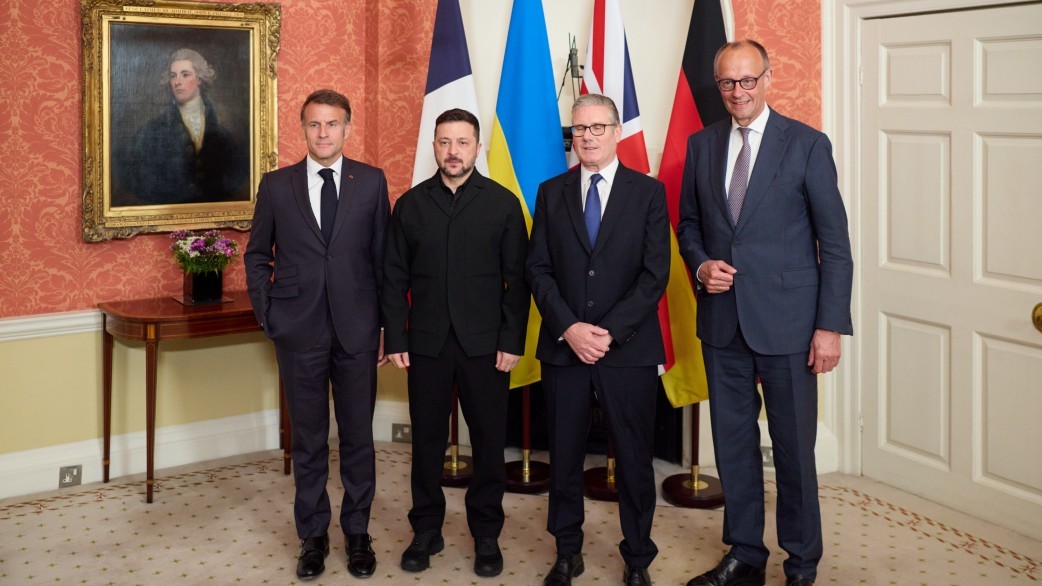
On December 7, 2025, at 10 Downing Street, the leaders of Great Britain, France, Germany, and Ukraine published a joint statement. It defines five conditions for a "fair and lasting peace." The document is a signal that Europe wants a seat at the negotiating table. The question is whether there will be a place for it there.
Five Conditions: What Was Actually Signed
The statement established a concrete framework for settlement. The first condition is an immediate complete ceasefire. The second is the current line of contact as a starting point for negotiations, without changing borders by force and with recognition of Ukraine's right to choose its own security alliances. The third is legally binding security guarantees for Kyiv after the ceasefire ends, including possible deployment of multinational forces. The fourth is that frozen Russian assets remain blocked until the end of aggression and compensation is paid to Ukraine. The fifth is that any decisions regarding the security architecture of the EU and NATO are made only with the consent of member states and allies.
"We want to stop the war so that it doesn't return. The fastest path is to freeze the front line and move everything to a diplomatic format."
President Zelensky, Sky News, June 7
Context: Why Now
The meeting took place at an extraordinarily dense diplomatic moment. Three days earlier, on June 4, Zelensky sent an open letter to Putin proposing direct negotiations—neutral location (Switzerland, Turkey, Arab countries), with participation from the USA and Europe. Moscow responded: Lavrov called the letter "nonsense," Peskov suggested Zelensky come to Moscow. This very impasse became the immediate reason for the London meeting.
In parallel, American-Ukrainian negotiations over a US peace plan hit a dead end. The main sticking point is Donbas: Washington and Moscow's previous 28-point plan essentially laid down a concession of Ukrainian territory, which Kyiv rejected. "There is a vision from the USA, Russia, and Ukraine—and we don't have a unified view on Donbas," Zelensky told Bloomberg on the eve of the meeting.
Additional pressure came from the new US national security strategy, which the Kremlin characterized as "corresponding to our vision." For London, this meant: if Washington moves away from firm support for Ukraine, Europe must demonstrate its own consolidated position—and do so publicly.
Marginalization—Openly Acknowledged Problem
Macron and Starmer lead a "coalition of the willing"—a group of countries coordinating post-war security guarantees for Ukraine. But they are effectively sidelined from American-Russian negotiations. This is why Macron formulated the goal openly on June 5: "We are the largest donors to Ukraine—and that's why Europeans must be around the negotiating table."
European leaders privately acknowledge: the initial American-Russian plan was drawn up without them and contained harsh conditions for Kyiv. The London statement is an attempt to change this dynamic by publicly cementing "red lines."
What Was Left Out
- A mechanism for monitoring compliance with the five conditions is absent from the statement—no institution, no sanctions for violations.
- Trump's position remains undefined: on the eve, he publicly expressed irritation with Zelensky, saying he "hasn't even read the proposal" from the USA.
- The Kremlin proposed Gerhard Schröder as a potential mediator—Kyiv and Brussels rejected the idea in May due to his ties to Putin.
- Zelensky insists: Ukraine has no right to give up its own territories—while the American plan, according to Kyiv Independent, provides for exactly that.
Starmer publicly stated he would not "pressure" Zelensky to accept any settlement. But if Washington continues to lean toward a deal with Donbas concessions, the durability of London's principles will depend not on signatures in the statement, but on whether London, Paris, and Berlin are ready to block any plan in which Europe does not participate as a full party.
If by the end of December the USA presents an updated peace plan without E3's participation in its development—the London statement will become either a starting point for joint transatlantic pressure, or a beautiful document with no consequences.





