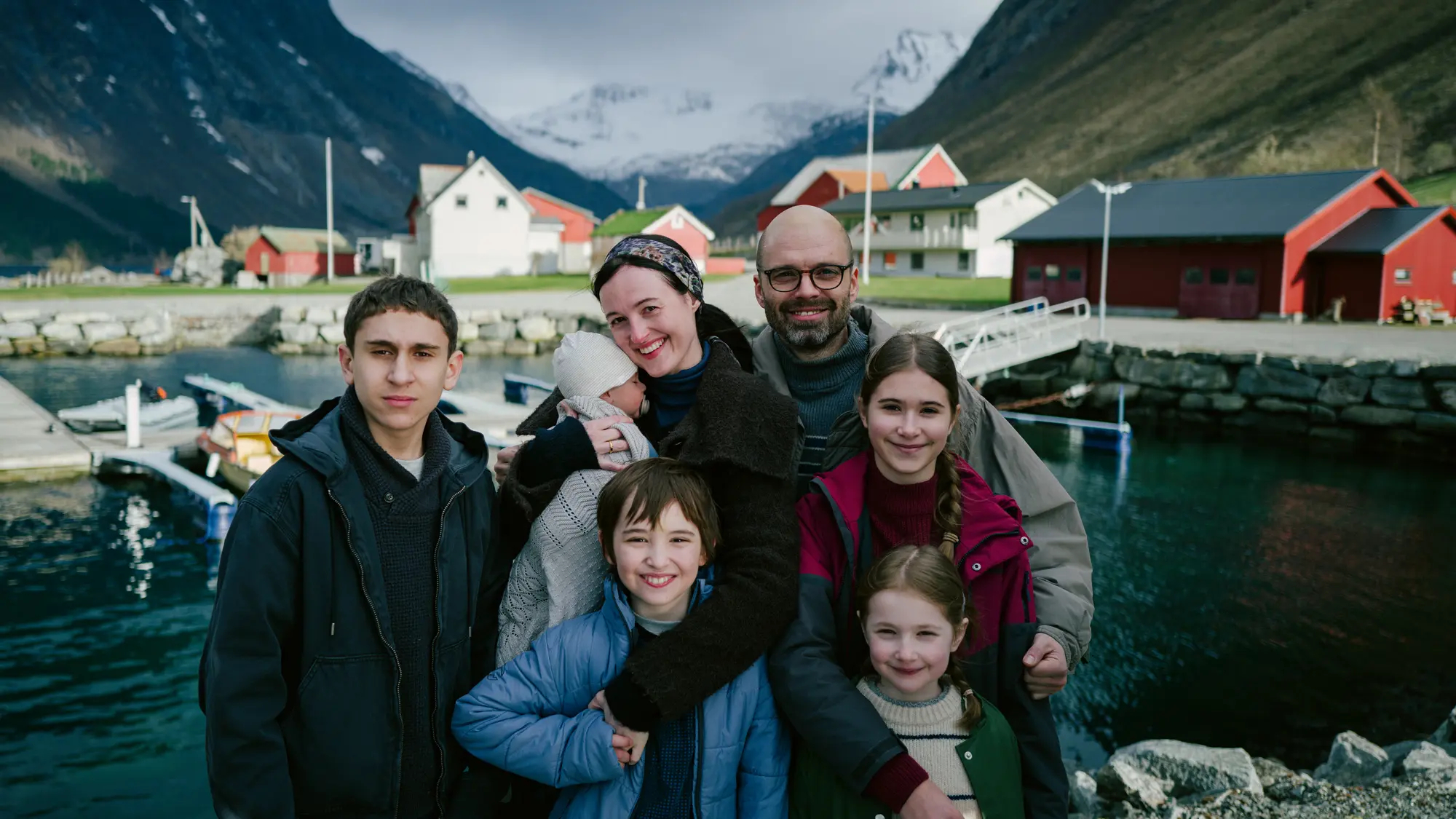
On Saturday evening at the closing ceremony of the 79th Cannes Film Festival, Cristian Mungiu became a member of a select club of two-time winners. His English-language debut "Fiord" received the Palme d'Or — for the Romanian director, this happened for the first time back in 2007, for "4 Months, 3 Weeks and 2 Days," a film about illegal abortion in communist Romania. Then — a totalitarian state against a woman. Now — a liberal state against a family.
Five Children and the System
The Georgiou family — a Romanian father, Norwegian mother, five children — relocates to a small Norwegian town near a fiord. They are evangelical Christians, and this becomes the trigger: neighbors report to the child protection service Barnevernet, suspecting that their parenting methods cross the line. What follows is a bureaucratic machine that, in theory, protects but in practice places the entire family under total surveillance.
The lead roles were played by Sebastian Stan and Renate Reinsve. At the premiere in the Grand Théâtre Lumière, according to The Hollywood Reporter, the hall held its breath throughout the screening — and after the credits, it took a long time to release the actors from the stage.
"This is an award I myself never received,"
— joked jury president Park Chan-wook before announcing the winner, alluding to his own Cannes "awards drought."
Why Not Just a "Family Drama"
Mungiu consistently builds his career on one fundamental question: who and by what criteria has the right to determine the norm? In "4 Months" it was the Soviet state. In R.M.N. — a xenophobic community in post-communist Romania. In "Fiord" — the Scandinavian welfare state, considered a model of progress.
This is neither an anti-Norwegian pamphlet nor a defense of religious conservatism. The film puts both sides in an uncomfortable position:
- the Barnevernet service acts according to protocol — but the protocol does not distinguish between violence and a foreign parenting culture;
- the family is convinced of its righteousness — but conviction in one's own righteousness is not the same as righteousness;
- the neighboring community reports — but from what motives: concern or xenophobia?
It is precisely this refusal of simple answers that, judging by the press reaction, has divided critics: Screen Daily called the film "scattered" due to tangential plot lines, Hollywood Reporter — "a film that broke the race for the Palme."
Seven Years in a Row — Neon
A separate festival story is the American distributor Neon, which acquired the rights to "Fiord" before the festival began. This is already the seventh consecutive Palme d'Or for the company — a streak with no precedent in Cannes history. For independent American distribution, this means not only prestige but also real box office expectations from an art house audience.
The film was shot in March 2025 in the Norwegian city of Ålesund — a city with distinctive Art Nouveau architecture on the Atlantic coast. The co-production involved six countries: Romania, Norway, Sweden, Denmark, Finland, and France.
If "Fiord" gets a wide theatrical release with the same resonance as it had on the Croisette, — the discussion about the limits of state interference in family life will extend far beyond cinemas. The question is whether viewers are ready for an ending without a verdict. The reaction of Norwegian child protection organizations to a film about their own system is still unknown — but it could prove more eloquent than any critical review.





