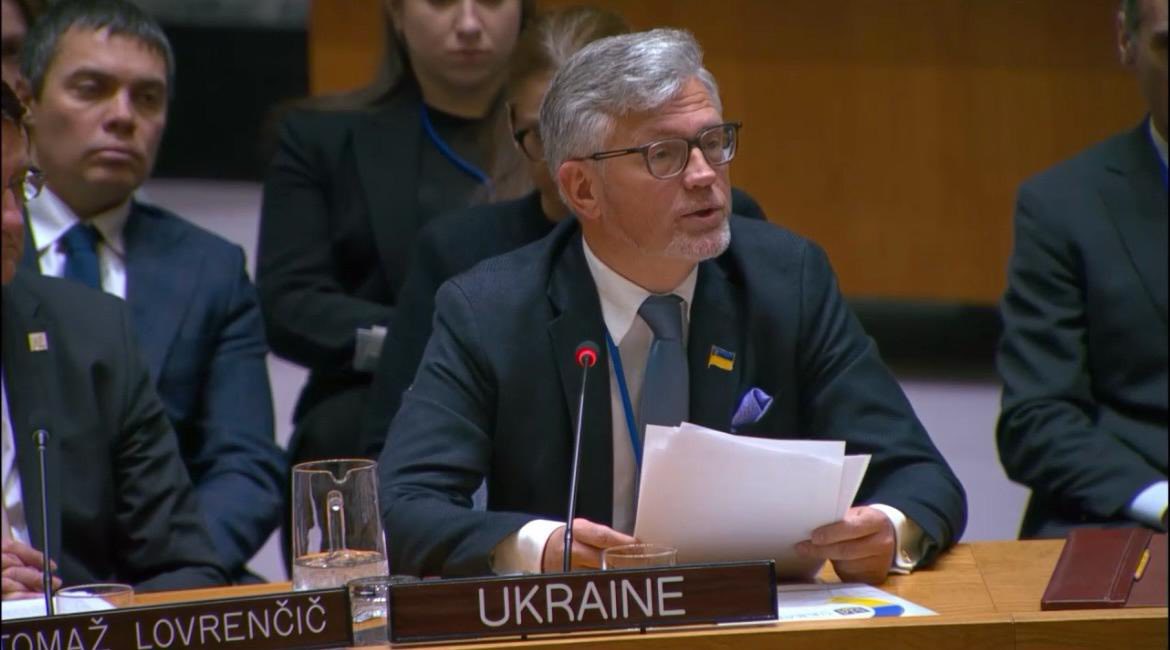
When Russia's representative Vasily Nebenzia began describing the suffering of residents in the Moscow region following a massive Ukrainian drone attack on May 17 at a UN Security Council meeting on May 19, Ukraine's permanent representative Andriy Melnyk responded without diplomatic restraint.
"Stop complaining about the suffering of poor Russians. What Russia is observing is a boomerang that it launched against Ukraine through Putin. It is returning with triple force and hitting very hard."
Andriy Melnyk, Permanent Representative of Ukraine to the UN, May 19, 2025
The May 17 attack on the Moscow region became one of the largest in terms of the number of drones involved since the beginning of the full-scale invasion. It was precisely this attack that prompted Nebenzia to convene an emergency session — and it was precisely this attack that became the starting point for Melnyk's speech.
The Logic of the "Boomerang" in International Context
Melnyk's argument is not an emotional outburst, but a specific legal position: Ukraine is acting within its right to self-defense under Article 51 of the UN Charter. Kyiv qualifies strikes against the territory of the aggressor from which attacks on civilian infrastructure are carried out as a legitimate military means of pressure, not escalation.
Russia has consistently used the Security Council platform as a megaphone for its own narrative — and has equally consistently blocked any resolutions condemning its actions thanks to its veto power. Melnyk chose a tactic that deprives this platform of its usual scenario: instead of accusations in response to accusations — reformatting the question itself. Not "did Ukraine have the right to strike Moscow," but "who started this cycle of violence and bears responsibility for it."
Kherson Region: Humanitarian Crisis Beyond the Security Council's Attention
In parallel with his response to Nebenzia, Melnyk raised an issue that was almost lost in the media noise surrounding Moscow drones: the humanitarian situation in the temporarily occupied territory of Kherson region. The ambassador called on UN member states to strengthen sanctions against Russia and provide additional support to civilians in occupied territories.
- Shelling of the left bank of Kherson region continues despite repeated appeals to international institutions
- Access for humanitarian organizations to temporarily occupied territories is effectively blocked by the Russian side
- The UN documents a shortage of medicines, water supply interruptions, and forced displacement of civilians
The fact that Melnyk combined these two topics in one speech was no coincidence. This is an attempt to keep in one focus both Ukraine's right to self-defense and the price paid by civilians in occupied territories.
What's Next
The UN Security Council is structurally incapable of adopting any binding decision regarding Russia — the veto power remains. But the platform remains an instrument for shaping international opinion. The question is whether the rhetoric of the "boomerang" will translate into concrete pressure: if the West does not strengthen the sanctions package after attacks on Moscow in the same way as after attacks on Kyiv, the difference in response will become an argument that Russia will use for years to come.





