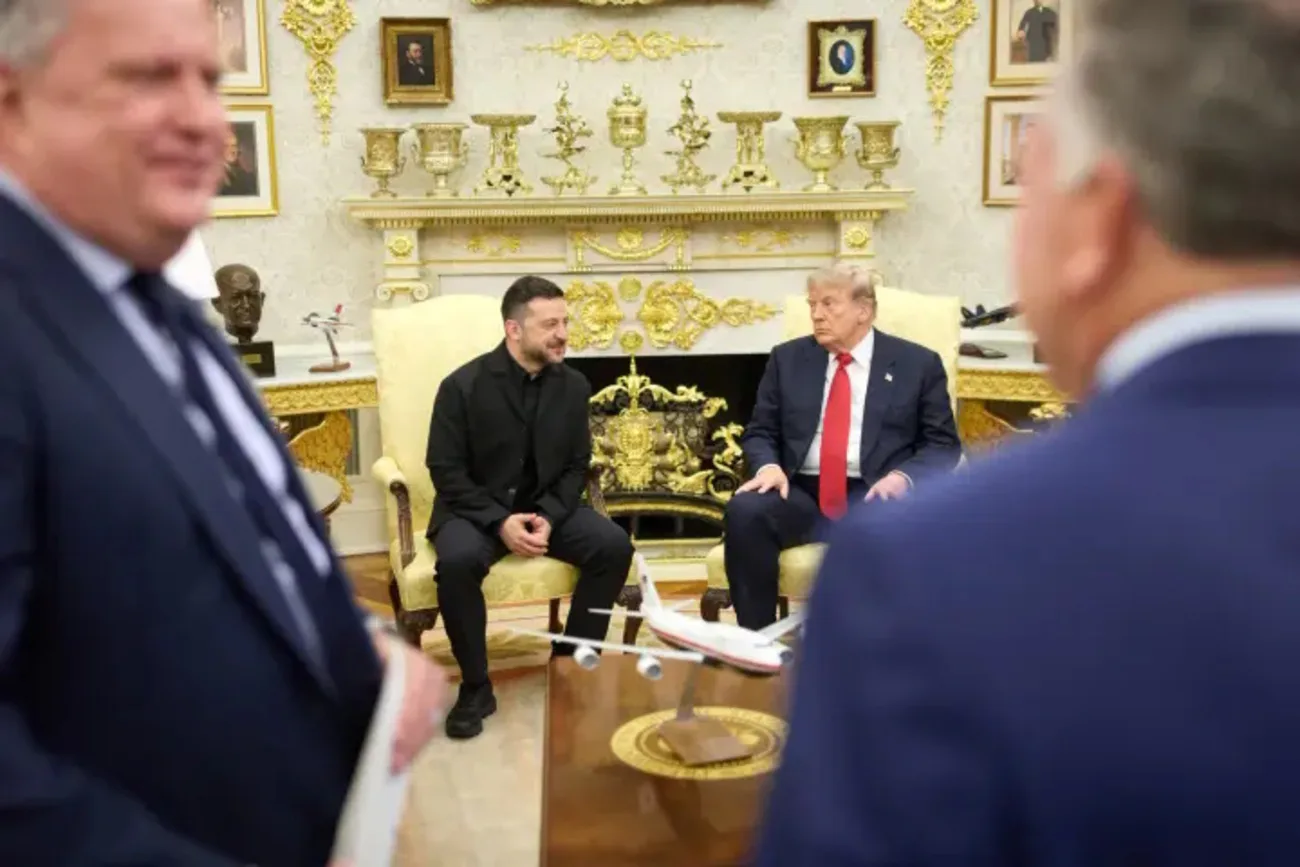
In February, Donald Trump on live air threw Vladimir Zelensky out of the Oval Office. In July, he praises him at the NATO summit and discusses licenses for Patriot air defense missile production. Media outlets explain this sharp change not by diplomatic talent, but by a simple fact: Trump found himself in a war where Ukrainian expertise suddenly became a commodity he needs.
What exactly happened over six months
UNN reports on the warming of relations citing The Guardian. After a sharp confrontation during a meeting at the White House, Zelensky left the American president's residence early, and Trump essentially refused to support the Ukrainian leader. But a series of subsequent meetings — including this week in Washington, where Zelensky arrived for Senator Lindsey Graham's funeral — went, according to analysts, far more constructively.
Charles Kupchan, senior fellow at the Council on Foreign Relations, formulates the change without diplomatic euphemisms:
Without a doubt, his attitude toward Zelensky has warmed. We have moved from a stage when he was throwing Zelensky out of the Oval Office and turning away from him, to a situation where between them, it seems, quite good relations have developed
Why exactly now
The timing is not accidental. A memorandum signed in June on a 60-day ceasefire between the US and Iran effectively lost its force after renewed hostilities around the Strait of Hormuz, which Tehran blocked at the beginning of the war. Iran began attacking American bases and US allies' infrastructure in Persian Gulf countries with drones — and it turned out that no one in the world has as much practical experience countering Iranian Shahed drones as the Ukrainians, who have been repelling these attacks since 2022.
In March, Zelensky told British parliamentarians that Ukraine had sent approximately 200 military experts to 11 Persian Gulf countries, consulting the UAE, Saudi Arabia, Qatar, and Kuwait on countering unmanned aerial vehicles. Trita Parsi, vice president of the Quincy Institute, sees in this a direct reason for Trump's change in tone:
At a moment when Trump is stuck in a war and dealing with bad military options, the Ukrainians suddenly turn to him not with a request for American charity, but with an offer of help. It is quite plausible that this could have been one of the reasons for his sharp change in attitude
Who benefits
For Zelensky, the benefit is obvious and long sought: to change the frame of conversation from "aid seeker" to "expertise supplier." Kupchan formulates it this way:
The arguments in favor of helping Ukraine have now become even more convincing, since Ukraine has demonstrated that it not only receives but also gives
Kyiv backs up this logic with a concrete proposal: Zelensky announced that Ukraine is ready to provide Washington with intelligence data about Russia's probable assistance to Iran in preparing attacks on American facilities, claiming that since early July Ukraine has been recording active Russian satellite reconnaissance of US bases in the Persian Gulf. In other words, the proposal is built not on abstract solidarity, but on an intelligence product that the Pentagon cannot obtain anywhere else.
For Trump, the benefit is different — and less romantic. Praise for Zelensky at the NATO summit in Ankara and the promise of Patriot licenses look more like payment for usefulness than recognition of righteousness. Notably, the American president later cast doubt on the implementation of this promise — the warming did not convert into firm commitment.
Opposition reaction: skepticism hasn't gone away
The personal warming between the two leaders did not change Trump's base position. MAGA movement supporters, as before, remain skeptical of US participation in foreign wars and allocating significant funds to Ukraine — and the fact that Washington is simultaneously balancing on the brink of a new conflict with Iran only strengthens their reluctance to open another front of spending and attention.
On the other hand, there is Tehran, for whom the rapprochement between Kyiv and Washington and Israel is read not as humanitarian aid, but as participation in a hostile coalition. Sina Toossi, researcher at the Center for International Policy, warns of the expansion of the geography of possible Iranian retaliation:
The likely consequence will be not an immediate missile strike on Ukraine, but an expansion of the list of places where Tehran will consider it legitimate to inflict damage
Kyiv's response to this risk is marked restraint. After Zelensky's meeting with Trump, Acting Foreign Minister Andriy Sybiga had a phone conversation with his Iranian counterpart Abbas Araghchi. According to Sybiga, Kyiv is not interested in further escalation, and all actions of Ukraine are aimed exclusively at protecting the state from Russian aggression — a formulation designed at once for Tehran and for its own public, which does not want war on two fronts.
Honest summary
Ukrainian expertise has indeed become a bargaining chip that softened Trump's tone after the February humiliation in the Oval Office. But the volatility of his position on Patriot and the persistent skepticism of the MAGA electorate mean that this warming is tactical, not strategic: it will last only as long as Washington needs Ukrainian help against Iranian drones. The question that remains open is: will Kyiv manage to convert this temporary usefulness into something long-term — concrete weapons guarantees — before the war with Iran (if it de-escalates) makes Ukraine less of a priority for the White House again.







