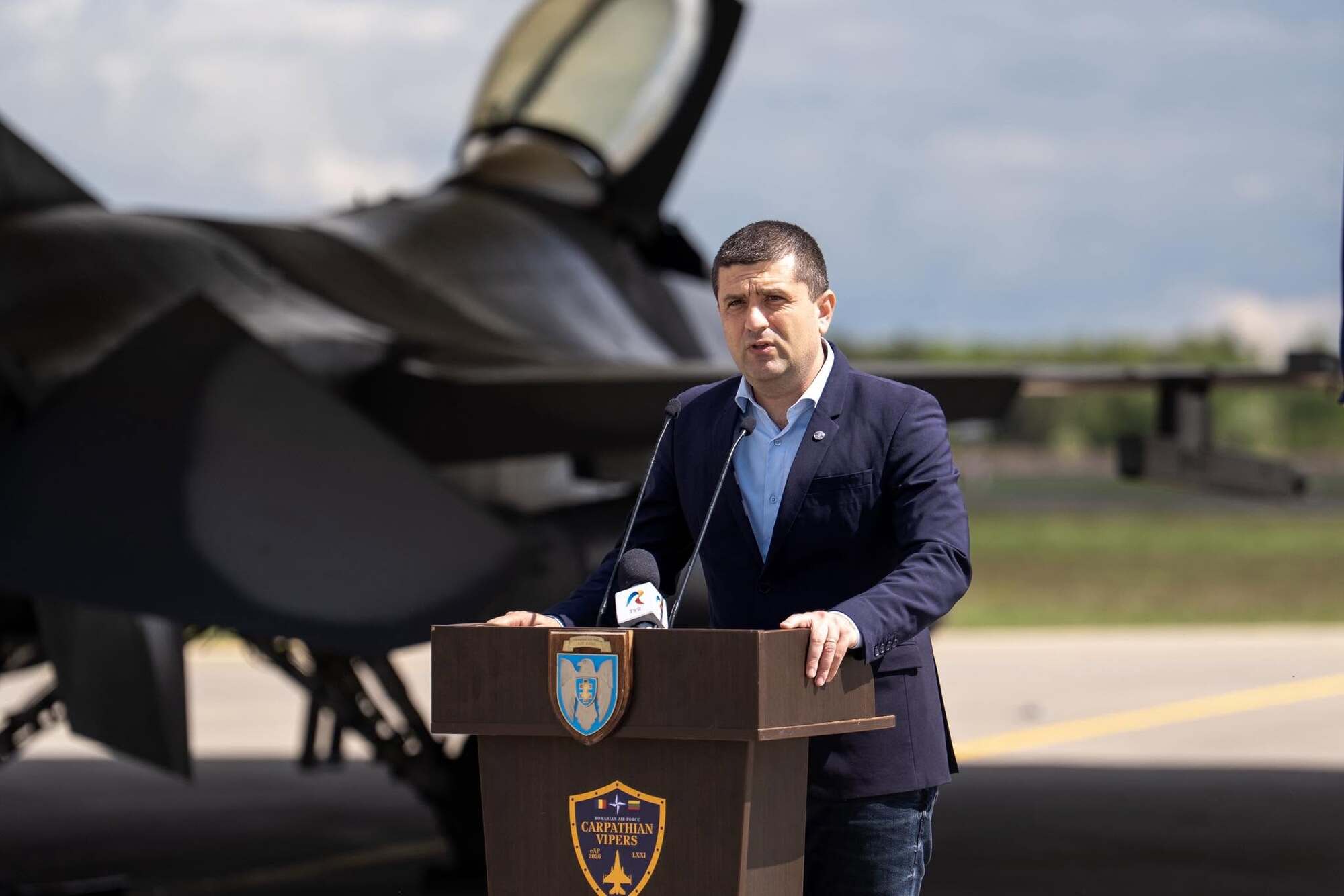
On July 24 and 25, Romanian F-16s twice shot down unmanned aerial vehicles that entered the country's airspace from the direction of the Black Sea and the border with Ukraine. President Klaus Iohannis personally confirmed both incidents, and acting Defense Minister Radu Miruță revealed details that deserve closer examination — they explain why combating drones costs Europe significantly more than it costs Russia to launch them.
Four Aircraft Against One Drone
To intercept just one unmanned aerial vehicle, Romania mobilized not two, but four fighter jets: a pair of Italian Eurofighter Typhoons patrolling NATO airspace from the "Mihail Kogălniceanu" air base, and a pair of its own F-16s. This was neither coincidence nor overcaution — it is the standard logic of NATO air patrol operations, where multiple aircraft are always deployed for each mission: one pair engages the target while another provides cover or duplicates the task in case of weapons failure or loss of contact.
The problem lies in the economics of such a decision. A "Shahed" type drone costs approximately 20,000 to 50,000 dollars. One hour of flight time for a modern fighter jet means thousands of dollars in fuel, engine wear, airframe degradation, not to mention the cost of an air-to-air missile, which is often an order of magnitude more expensive than the target itself. When four aircraft are needed for one target instead of a specialized inexpensive solution, the arithmetic works against the defender.
Why Uninhabited Territory Matters
Iohannis specifically emphasized that the first drone was shot down near the Padina commune, and the territory was uninhabited, allowing the pilot to open fire without risk to civilians. This is not a formality. Debris from a destroyed drone or missile falls to the ground with the same kinetic energy as the projectile itself, and the decision to open fire over a populated area is always a compromise between neutralizing the threat and the risk of civilian casualties on the ground. This is precisely why Poland consciously refrained from shooting down some targets over cities during a massive drone attack in September.
An Admission Usually Avoided
Miruță directly stated that Romania needs more modern air defense systems against drones, calling this an investment that cannot be postponed. The formulation "threats are no longer what they were ten years ago" is essentially an admission that the current air defense architecture, designed for full-scale aircraft and missiles, is poorly adapted to handle mass-produced inexpensive drones that fly slowly, low, and unpredictably.
This is confirmed by a series of previous incidents: in May, a drone crashed into a residential building in Galați; in July, the cargo ship Christiana B was damaged near the Romanian coast. Each incident individually appears to be an isolated case, but together they form a picture of systematic pressure on the airspace and maritime space of a NATO country, occurring without formal declaration of war.
What This Means for the Region
Romania is not the only country facing this dilemma. Poland last September intercepted more than two dozen drones simultaneously, and the question of interception costs was even more acute there. If the trend continues, the next logical step will not be the purchase of additional fighter jets, but the deployment of cheaper specialized systems — such as interceptor drones or laser/electronic countermeasures, which cost many times less than air-to-air missiles.
The question is whether Romania and the rest of NATO's eastern flank will have time to restructure their air defense system to match drone prices before the number of incidents becomes a permanent burden on the defense budget — or if they will continue to launch fighter jets worth tens of millions against targets worth tens of thousands.







