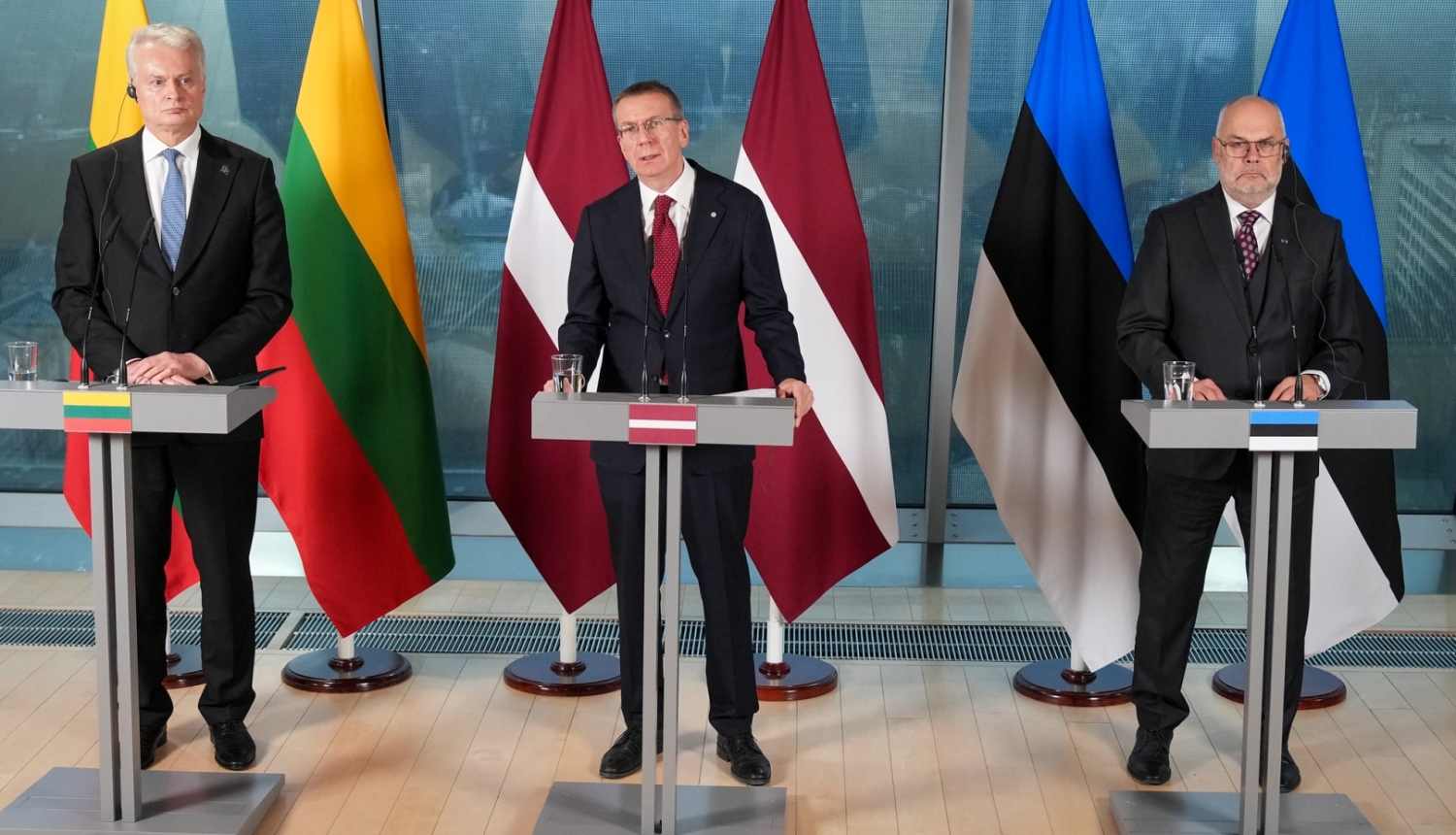
During March 23–25, three Baltic states recorded drone intrusions into their airspace within less than 48 hours. A series of incidents prompted a joint statement by the presidents of Estonia, Latvia, and Lithuania, raising an uncomfortable question: whose drones are these — and who really determines their flight path?
What happened: from a smokestack to a military range
The most dramatic episode occurred on March 25, around 3:43 a.m.: a drone crossed Estonian airspace from the Russian side and crashed into the smokestack of the Auvere power plant in Ida-Virumaa County — less than 50 kilometers from the Russian port of Ust-Luga, which Ukraine attacked that same night. Enefit Power reported that the plant's capacity was not affected and there were no casualties.
This is not the first such incident. Back in summer 2025, Lithuania recorded two intrusions by Russian-origin Gerbera drones from Belarus — the second one was found at the Gaižiūnai military range with approximately two kilograms of explosives, 100 kilometers deep into NATO territory. In August, fragments of a Ukrainian drone were found near Elva in Estonia; in September — Gerbera fragments on Latvia's coast.
Technical mystery: accident or deliberate deviation?
The West's official version is "an unfortunate accident." Ukraine acknowledged that drones were headed toward military targets in Russia but lost their way due to Russian electronic warfare means. However, Lithuania's Foreign Minister Kęstutis Budrys was more blunt:
"Russia deliberately redirects Ukrainian drones into Baltic airspace using electronic interference."
Kęstutis Budrys, Foreign Minister of Lithuania
Latvian Deputy Chief of the Joint Staff Ēģils Lēščinskis confirmed that the object that exploded in the Kraslava area was detected on radar only ten minutes before impact. "The device most likely deviated from its course or was affected by electronic warfare means," he said. Whether this resulted from protecting Russian infrastructure or was a deliberate operation remains to be determined by the investigation.
What Tallinn, Riga, and Vilnius are demanding
The defense ministers of the three countries, followed by their presidents, published joint statements with specific demands for NATO:
- accelerate efforts to strengthen multilayered air defense, including protection against UAVs;
- support and expand the presence of alliance aviation and air defense systems in the region;
- allocate EU funding for the European Counter-Drone Defense Initiative and the Eastern Flank Watch program.
At the same time, all three states confirmed their support for Ukraine and its right to self-defense — despite the fact that Ukrainian drones feature in most of the new incidents. An anti-drone system that Poland and Romania have already deployed following similar 2025 incidents is still absent in the Baltics.
The price of diplomatic silence
Practical consequences are already felt: in Latvia, following intrusions on May 7, the defense minister and Prime Minister Evika Siliņa resigned. For the first time in the capital of a NATO and EU member state — Vilnius residents took shelter in underground parking lots during drone alerts.
Estonia's Internal Security Department Director Margo Pallossón stated the position plainly: "These are the consequences of Russia's full-scale aggressive war. We can assume there will be more such incidents."
If NATO accelerates the deployment of anti-drone systems in the Baltics by the end of 2026 — the statement of three presidents will remain in archives as diplomatic pressure. If not, the next drone over Vilnius or Tallinn could become not a technical accident, but a test of what Article 5 means in the era of cheap unmanned aircraft.





