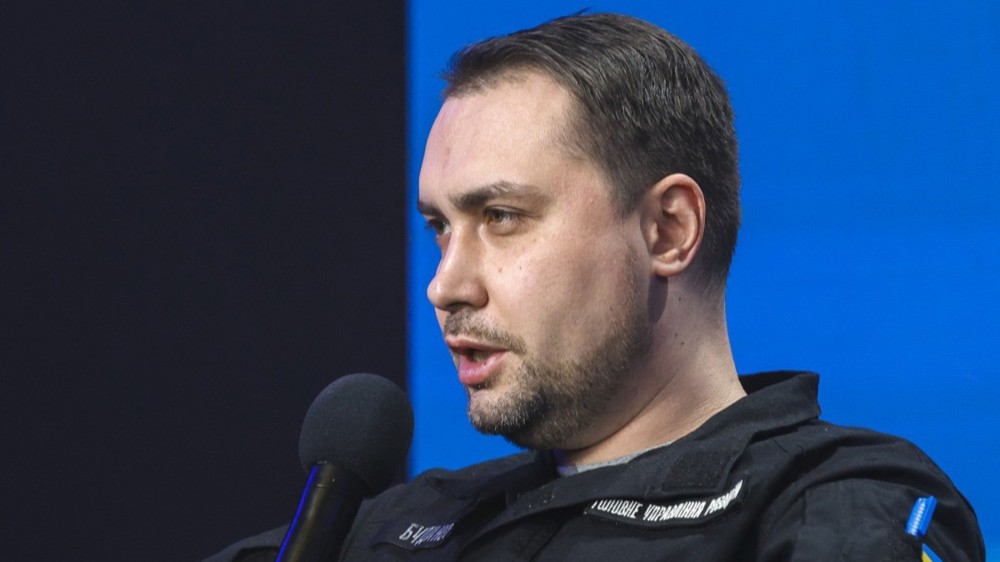
Kyrylo Budanov, recently appointed head of the President's Office and former chief of the GUR, gave an interview to the British newspaper The Times, published on May 15. The material is notable not for its reassuring tone, but for the analytical distinction that has been publicly lacking for months: Russia can — but is not preparing.
What happened before May 9
A wave of intimidation began on May 6-7 — following successful strikes by the Ukrainian Armed Forces on the Shaykivka and Kubinka airfields near Moscow. Russian propaganda began speaking of inevitable strikes with the "Oreshnik," and the Kremlin warned a number of Western countries about the advisability of evacuating their embassies from Kyiv. At the same time, the European Union publicly refused to reduce its diplomatic presence.
According to Budanov, the threat of a massive strike on central Kyiv was real in the sense that Russia was indeed prepared to carry it out — if Ukraine had prevented the parade on Red Square. In other words, it was not purely a propaganda spectacle, but a conditional state of readiness.
Two different questions in one phrase
"Russia, without a doubt, has the capability to deliver a nuclear strike at any moment and at any distance. Its nuclear potential allows it to accomplish such a task. But this is, first and foremost, a question of political will. I have not seen any signs of preparation for a nuclear strike. If there had been, I would know about it."
Kyrylo Budanov, The Times, May 15, 2025
This quote does what most official comments avoid: distinguishes between technical capability and political decision. The first is indisputable. The second has not yet been recorded by any intelligence signal. This is where the practical value of the statement lies: not "do not be afraid," but "here is what we are monitoring and what we are not seeing yet."
Context: "Oreshnik" as a pressure tool
Three months earlier — in February — Moscow had already launched a similar wave. Then in March, following a massive drone attack on Moscow. Now — May. ISW analysts have identified a pattern: the Kremlin resorts to "Oreshnik" rhetoric at critical moments when it needs a lever of pressure, not actual escalation. On May 12, already after the parade, Putin publicly boasted about testing the "Sarmat" and the range of the "Oreshnik" — which reads more as a demonstration than preparation.
An important detail: expert Ivan Stupak previously described a real indicator — a U.S. embassy warning of elevated threat within 72 hours. During the previous actual deployment of the "Oreshnik," the American side evacuated personnel. This time, there was no such signal.
Why Budanov is saying this
Budanov took over the President's Office in January 2025 after nearly five years leading the GUR. He simultaneously conducts peace negotiations with Moscow and, by his own account, remains a target for the Kremlin. This is his first public statement in his new role with a specific intelligence assessment — and he chose a British publication rather than a Ukrainian one, which in itself is a signal to the Western audience.
If Budanov is right and nuclear readiness is indeed being monitored at a level where "he would know" — the question becomes different: will this indicator remain reliable if Russia intentionally begins to mask its preparations from an intelligence service that knows its methods?





