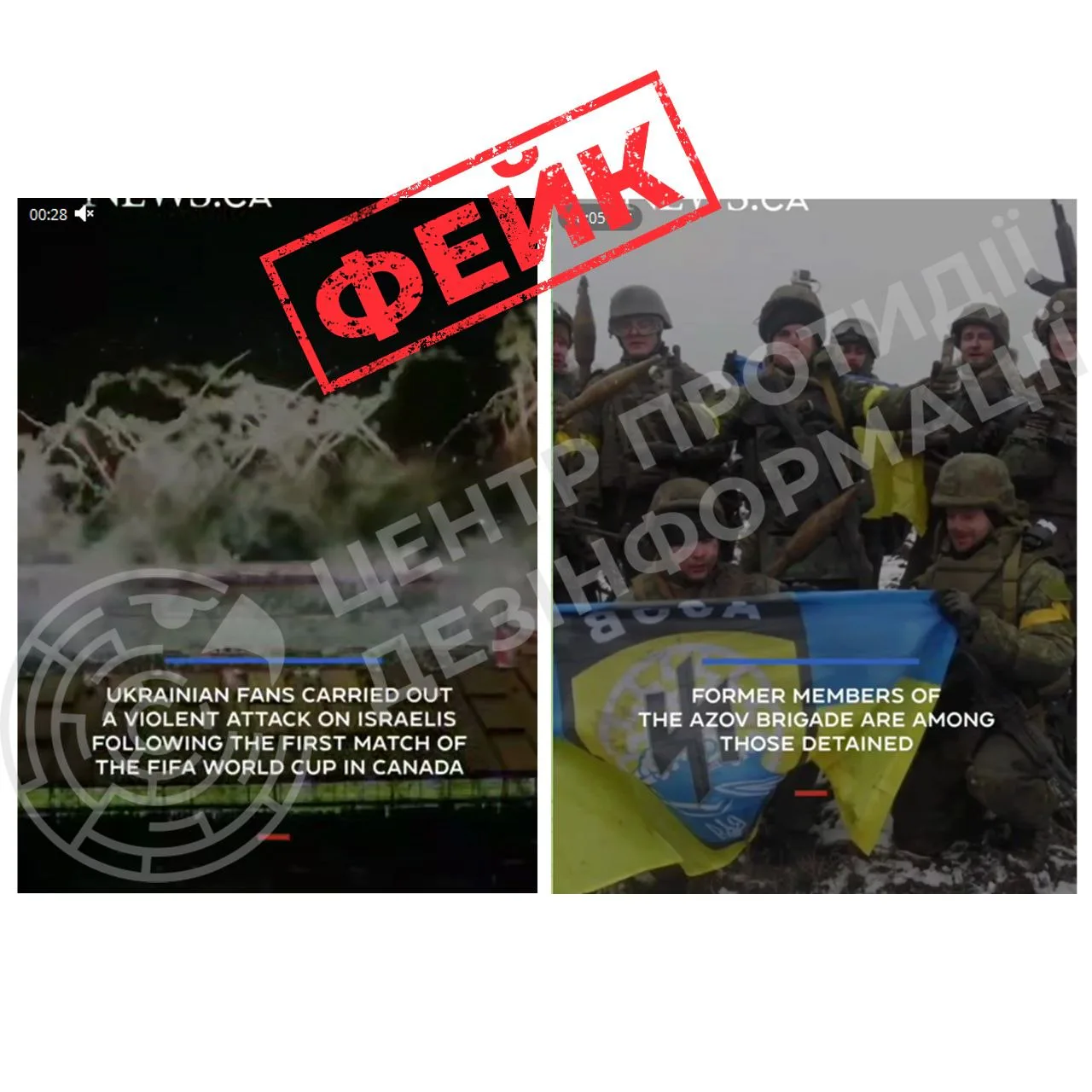
On the eve of the 2026 FIFA World Cup, Russian disinformation networks launched a new narrative: Ukrainian fans allegedly attacked 20 Israeli supporters. The video circulating on social media was formatted to resemble material from the Canadian television channel CTV News — complete with logo, corporate graphics, and imitation of reporting style.
The Center for Countering Disinformation at the National Security and Defense Council of Ukraine established that the recording is a forgery. The CTV News logo was used without any connection to the actual news organization — the channel never published such material. This is a classic "borrowed authority" technique: fake content is made to look like verified media to reduce the audience's critical perception.
Why football and why now
The choice of topic is not accidental. International sporting events are an environment of heightened emotions and global reach. An incident between fans from different countries instantly becomes international news, while debunking always lags behind the initial spread.
There is an additional calculation involving the Israeli-Ukrainian context. Since October 2023, the issue of Israeli citizens' safety abroad has been extremely sensitive. Framing Ukrainians as aggressors against Israelis is an attempt to simultaneously play on two painful points and create a wedge between countries that maintain diplomatic relations.
Operation mechanics
The Center for Countering Disinformation identified several characteristic signs of a coordinated campaign: the video appeared simultaneously on multiple platforms, had pre-prepared translations, and was distributed by accounts showing signs of network coordination. This is not an isolated "prank" — this is content created for a specific purpose.
The scheme of forged brands from well-known media has been used before — particularly, materials supposedly from the BBC and Reuters about alleged crimes by Ukrainian military personnel. Each time the logic is the same: the trust in the brand is transferred to the fake content.
What this means beyond one video
A single video clip is a trifle. But a series of such operations forms a sediment: "I heard something somewhere about Ukrainian fans," "it seems there were some scandals." This very sediment is the goal — not to convince, but to sow doubt in the international audience that does not follow Ukrainian rebuttals.
The 2026 World Cup will take place in the United States, Canada, and Mexico. If Ukraine's national team qualifies, tens of thousands of Ukrainian fans will be in the media spotlight. The preparation for discrediting this audience appears to have already begun.
The question is not whether Russia will succeed in convincing anyone with this particular video. The question is whether international platforms and media will manage to develop a systemic response to branded forgeries before the tournament starts and the stakes rise.