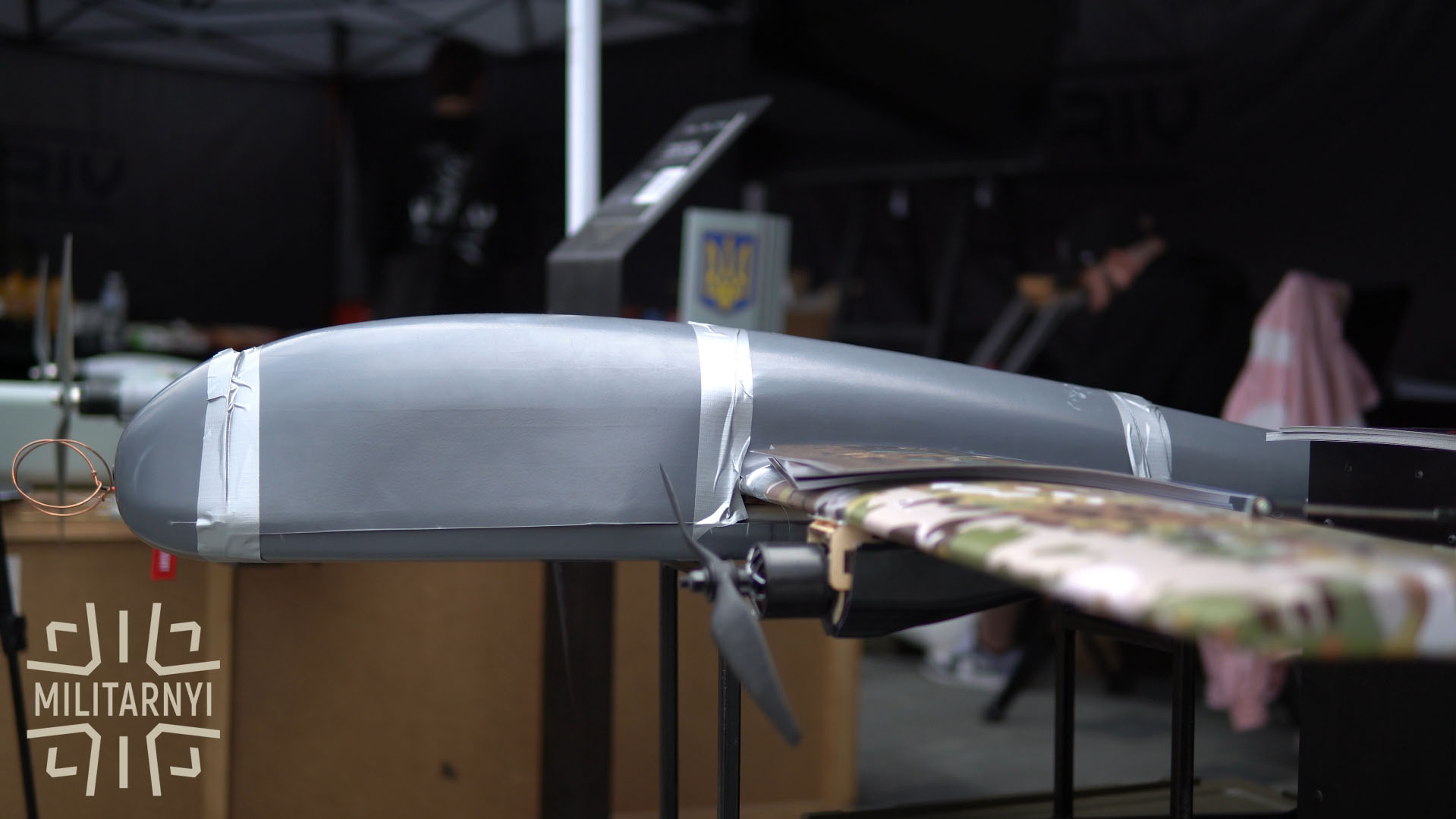
At the "Wild Drones" exhibition, Vyriy company unveiled an updated version of its strike unmanned aerial vehicle "Bliskavka". Externally, there is one change — an aerodynamic fairing. In terms of impact on characteristics — considerably more.
What is a fairing and why is it important
A fairing is an aerodynamic casing that forms a streamlined body around the drone's components. Its purpose: to reduce drag during flight. According to the manufacturer, after installing the fairing, the approximate range of "Bliskavka" increased by approximately 30%. The drone also became more stable in the air and better withstands wind gusts — which is critical for accurate targeting in the final section of the trajectory.
It is important to understand the context: no new engine, new batteries or changes to the airframe structure — only aerodynamic refinement. This is a relatively inexpensive design solution with a disproportionately large effect.
What the basic "Bliskavka" can already do
"Bliskavka" is a fixed-wing strike UAV developed by Vyriy based on a captured Russian drone "Molnia". According to Vyriy founder Oleksiy Babenko, engineers did not copy the design but reproduced the concept: a simple, inexpensive medium-range platform for mass application.
"We were guided not by the specific design of the 'Molnia', but tried to maintain the concept it represents: a simple, accessible medium-range platform designed for mass application".
Oleksiy Babenko, Vyriy founder — Wikipedia / Military
In the basic configuration, the drone has two electric motors on the wings, launches from a pneumatic catapult in 10 minutes, and the crew can leave the position in 5 minutes. Cruising speed — up to 110 km/h, maximum — up to 140 km/h, ceiling — 2000 m, flight time — up to 60 minutes. Tactical radius — 40 km, with a repeater — up to 80 km. Payload capacity — up to 8 kg according to manufacturer recommendations; documented cases of combat use with payloads up to 13 kg.
The cost of one drone is 35,000 hryvnias. "Bliskavka" is already in serial production and supplied to Ukraine's Defense Forces, and is also available for purchase through the DOT-Chain Defence platform and the "Army of Drones. Bonus" program on Brave1 Market.
Not just range: control via Starlink and fiber optics
In parallel with aerodynamic modernization, Vyriy has expanded the drone's control system. According to Babenko, "Bliskavka" can already be controlled through fiber optics, Starlink satellite communication, and LTE system with digital video channel. Work is also underway on an optional guidance system and cruise flight mode — details are not yet disclosed.
- Fiber optics — protection from electronic warfare at close ranges
- Starlink — stable channel at long distances
- LTE with video — flexibility in network coverage areas
The combination of these channels with the potential increase in range after fairing installation makes the platform significantly more difficult for electronic suppression.
Scale and logic
In March 2025, Vyriy presented the first serial batch of 1,000 drones made from Ukrainian-origin components. At the Defense Tech Valley exhibition in September 2025, the company showcased four more new developments — the ground robotic system "Dzhankoy", the mother drone "Veresen", and the reconnaissance "Sokil". "Bliskavka" remains the basic strike product of the lineup — and it is precisely its scale that makes any performance improvement strategically significant: +30% range on thousands of drones — this is not an upgrade, this is a different geography of impact.
If the modernized "Bliskavka" confirms its stated characteristics in combat conditions and Vyriy maintains the price within 35,000 hryvnias per unit — the question is no longer whether the fairing will become standard for the serial batch, but rather when exactly this will happen and whether the production line can keep up with demand.







