When an army fights worse than it promised its society, its regime seeks compensation elsewhere. Lithuania's Defense Minister Robertas Kaunda articulated precisely this logic in a live LRT Radio broadcast: Russia's failures in Ukraine are turning the Baltic region and Poland into potential targets for new escalation.
«The war in Ukraine is not going as Russia planned. The Kremlin needs new escalation — and the Baltic region, Poland, are the nearest targets in this case».
Robertas Kaunda, Lithuanian Defense Minister
This is not the first such warning. In April 2025, Russian Foreign Intelligence Service Director Sergey Naryshkin named Poland and the Baltic states as «the first to suffer» in case of escalation with NATO. Zelensky sent a similar signal, suggesting that Baltic states could be the next target — and adding that «some of them are not ready for strong resistance».
Why specifically Estonia — and what it's doing about it
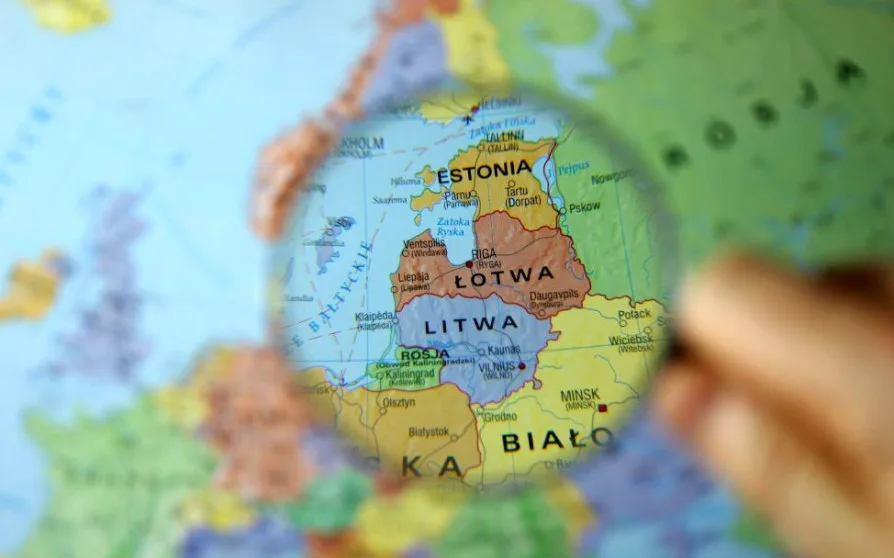
Among the three Baltic states, analysts from the European Council on International Relations single out Estonia as the most vulnerable: a small army, limited logistical routes, depots vulnerable to precision strikes, and maintaining dispersed forces under artillery and drone fire is extremely difficult. 2025 even brought a popular book by Carlo Masala, If Russia Wins, with a scenario of Russia's successful invasion of Estonia in 2028.
But it is Tallinn that responded to these assessments most harshly. Estonian Foreign Minister Margus Tsahkna formulated a new doctrine concisely: don't let Russia in at all.
«Previous plans were like this: if Russia comes — NATO will eventually win. But by then there will be no Estonians left. That's why we are not interested in such plans».
Margus Tsahkna, Estonian Foreign Minister
In January 2025, NATO launched the Baltic Sentry mission — a joint operation to protect critical infrastructure in the Baltic Sea, which became a response to a series of suspicious underwater cable damages.
Where the thinnest spot on the map is
Strategists have long marked the Suwalki Corridor — a 65-kilometer strip between Kaliningrad and Belarus — as the most sensitive point of NATO's entire eastern flank. Lithuania's Ambassador to NATO Darius Jauniškis recently pointed out a paradox: Sweden's accession to the Alliance encircled Kaliningrad in NATO's surroundings, which only increases the value for Moscow of any «corridor» scenario. According to the ambassador, supplies to Kaliningrad from mainland Russia have already been reduced by 40–50%.
Wargame, organized by the German newspaper Die Welt together with former NATO and Bundeswehr officers, modeled a Russian invasion of Lithuania — and showed that most objectives could be achieved in the first 24 hours before reinforcements arrive.
Evacuation as a mirror of real threat assessment
The most telling indicator of how seriously these risks are taken by the governments themselves is not statements, but civil planning. After signing a civil protection agreement in May 2025, Lithuania, Latvia and Estonia are jointly preparing the evacuation of approximately 400,000 people living in a 40-kilometer zone from the borders with Russia and Belarus. In Kaunas, schools, universities and churches have already been designated as reception points.
- In Estonia, temporary shelters are being prepared for 10% of the country's population.
- In Narva — a city with a predominantly Russian-speaking population on the border — evacuation could involve up to two-thirds of residents.
- The Suwalki Corridor in any scenario will have priority for military equipment, not civilians.
At the same time, Latvia's Foreign Minister Baiba Brāže and Estonian officials emphasize: there are no signs of preparation for an immediate attack. The current risk is hybrid operations and sabotage, not conventional invasion.
The real conflict here is not between «Russia will attack» and «Russia will not attack», but between two deterrence logics: are declarations of readiness to fight «to the last» sufficient — or are they themselves a provocation that facilitates the Kremlin's internal political mobilization? If Russia truly makes a bet on limited provocation to test Alliance unity — the response of Berlin and Paris in the first 48 hours will determine whether deterrence works at all.