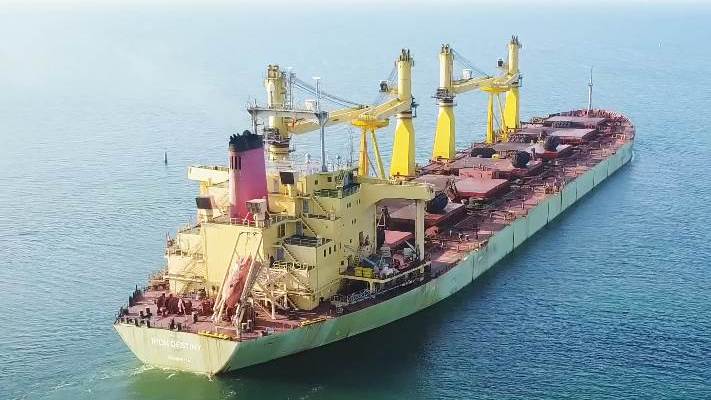
On April 20, Ferrexpo plc announced the sale of the bulk carrier-loader Iron Destiny for $7.7 million and its intention to attract up to $100 million from shareholders through recapitalization. At first glance — typical anti-crisis measures in wartime. In reality — the final point in a chain of decisions that began with an NSDC decision in February 2025.
A vessel with nowhere to sail
The 245-meter Iron Destiny, equipped with four Liebherr cranes, was built for one purpose: to transship iron ore pellets from barges to capesize vessels directly in the Black Sea, so that Ferrexpo could compete with Brazilian and Canadian suppliers in Asian markets. The company purchased the vessel in 2012. Since February 2022, it has been idle — Black Sea traffic is blocked, and the timeline for resumption is unknown to anyone. The board of directors decided not to wait.
Seven million seven hundred thousand dollars is less than one week of frozen VAT that the company is currently not receiving from Ukraine.
The true source of the crisis
On February 12, 2025, the NSDC imposed indefinite sanctions against Ferrexpo's majority shareholder Kostiantyn Zhevago (49.32% of shares) — officially for "systemic interaction with the aggressor country's economy" and criminal proceedings regarding the withdrawal of over $100 million from the failed "Finance and Credit" bank. The sanctions are personal — formally they do not apply to Ferrexpo itself. However, already in March, the tax service suspended VAT refunds to Poltava and Yeristivsk mining and beneficiation plants, citing these very sanctions.
"Personal sanctions against Zhevago should not be used as a tool of financial pressure on Ferrexpo, where the majority of voting shares belong to international investors, including the world's largest banks, investment, pension and sovereign funds."
— Ferrexpo plc, official statement
By the end of March 2025, the state's debt to the company for VAT refunds reached approximately $80 million. Another $13 million of the company's total $35 million in liquidity is frozen in MBaer Merchant Bank and inaccessible. Free funds remaining amount to approximately $22 million.
What $100 million from shareholders means
Recapitalization is a last resort: it dilutes existing shareholders' stakes. Ferrexpo shares on the London Stock Exchange have already fallen to new 52-week lows — 36.50 pence — and in some sessions trading volumes exceeded the average daily figure by 900%. The company warned: without new financing, current liquidity will last a maximum until the end of June 2026.
In parallel, other pressures continue:
- The SBI has initiated a procedure for the de facto nationalization of 49.5% of Poltava mining and beneficiation plant shares;
- A civil claim against the plant for 157 billion hryvnias ($3.76 billion) remains in force;
- "Maxi Capital Group" is attempting to recover another 4.7 billion hryvnias through bankruptcy proceedings;
- Production has been cut in half — of four pelletizing lines, only one is active.
According to financial director Mykola Klavdiyev, due to VAT blockage, the company has already transferred 37% of its workforce to reduced work weeks or leave. Capital investments in the first half of 2025 are half the planned amount: $28 million instead of the $102 million annual plan.
The logic of conflict
Ferrexpo is a public company on LSE, where approximately 75% of shares are held by international funds, including BlackRock (6.74%). Sanctions against Zhevago strike not only at him: they freeze VAT returns to enterprises where foreign investors predominate, and effectively lead to production cuts by a strategic exporter during wartime. The president of "Ukrmetallurgprom" Oleksandr Kalenkov directly called this "the biggest blow to Ferrexpo."
Zhevago denies the accusations and told Forbes Ukraine that no new investments in the company will be forthcoming if the threat of expropriation does not disappear. He himself is under a travel ban in France.
If Ferrexpo does conduct recapitalization and attract $100 million — a key question will remain open: will international investors agree to invest new money in a company where the state-beneficiary of its recovery is simultaneously the source of its crisis, and will the $80 million in frozen VAT be unblocked before June 2026 when liquidity runs out?







