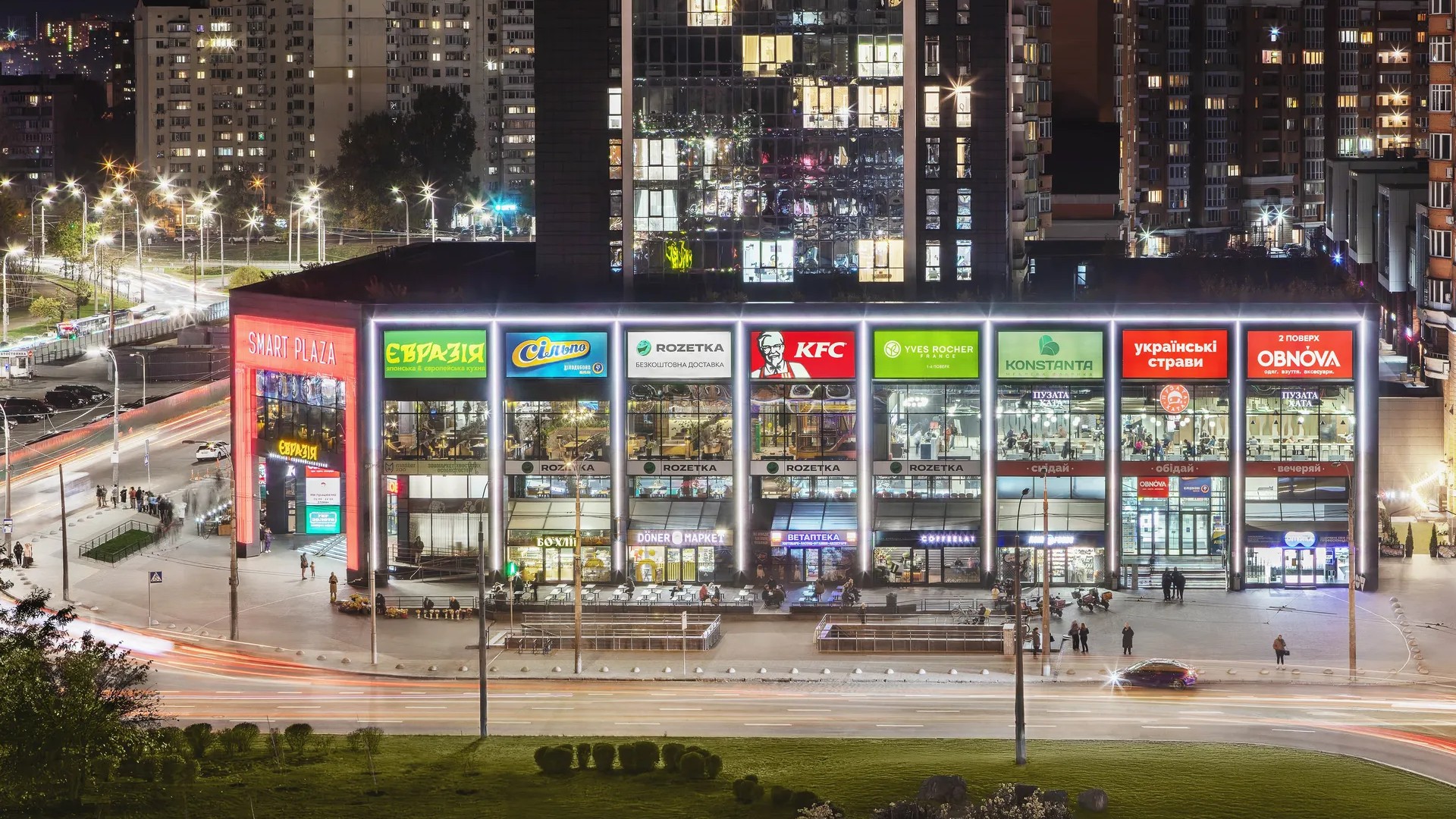
As of September 1, Oleg Balyash's company "Leviter" became the owner of the Kyiv shopping mall Smart Plaza Obolon near the Minskaya metro station, according to the Retailers Association of Ukraine. Previously, since 2019, the property belonged to the investment company Dragon Capital, founded by Tomash Fiala.
Balyash is a Lviv businessman, known primarily as the owner of Oxi Bank. The agreement to purchase the shopping mall was supposed to be reviewed by the Antimonopoly Committee of Ukraine – without its approval, such an operation is impossible. The deal amount is not disclosed.
What they buy and why
Leviter already owns a similar shopping mall – Smart Plaza Polytech, so the logic of the purchase is not about diversification, but about scaling one format. "These properties were developed by one developer, they have a common architecture, operational format and, to a large extent, the same pool of tenants. Strategically, our idea is to gradually develop both shopping malls as a network," Balyash explained.
The new owner does not plan to drastically change the concept of Smart Plaza Obolon. "The shopping mall is in good technical condition and does not require large capital investments, but we will consider individual local initiatives. Among the ideas is, in particular, the development of parking infrastructure," the businessman said, adding that he does not plan to resell the property and considers this purchase a long-term investment.
The shopping mall is located near the exit from Minskaya metro station, has approximately 15,000 square meters of total area and 10,000 square meters of rental space. Among the tenants are Silpo, Sinsay, Rozetka, KFC, and EVA.
One deal – two different markets
This transaction looks like an ordinary, voluntary, strategic purchase: private capital buys a stable, ready-made asset from a private seller, both parties act freely, the mechanism is a commercial deal under the supervision of the Antimonopoly Committee. But at the same time, a completely different story is unfolding with other Kyiv shopping malls.
In early August, one of the largest shopping malls in Kyiv – "Gulliver" near the Palace of Sports metro station – was put up for auction for $207 million. This is not a voluntary sale: in July 2025, a consortium of Oschadbank and Ukreximbank acquired ownership of the Gulliver commercial-office complex, which served as security for a loan that the former owner stopped servicing. State banks have been trying to reach an agreement with the debtor for years, and only after a complete payment default did the asset transfer to their ownership through a collateral collection procedure, rather than through negotiations between equal parties.
Another notable shopping center "Metrograd" will likely be closed and converted into a parking lot if it can be confiscated from Russian owners – meaning the mechanism here is not market-based at all, but rather sanctions-based and judicial.
The difference in mechanisms is key. The purchase of Smart Plaza Obolon does not obligate anyone to anything except the two private parties to the deal: it is not a declaration of confidence in the market as a whole, but rather a specific calculation by a specific investor regarding a specific asset with a known tenant pool and clear cash flow. The sale of "Gulliver" and the fate of "Metrograd" depend on completely different procedures – bank collateral collection and state confiscation – and it is they, not isolated deals like Obolon, that will show whether capital is ready to enter commercial real estate in Kyiv where the risk is not covered by a stable tenant and a clear owner.
The question for September: will a buyer be found at the "Gulliver" auction at the starting price, or will the asset, like the previous time with the debtor, have to be revalued downward once again?