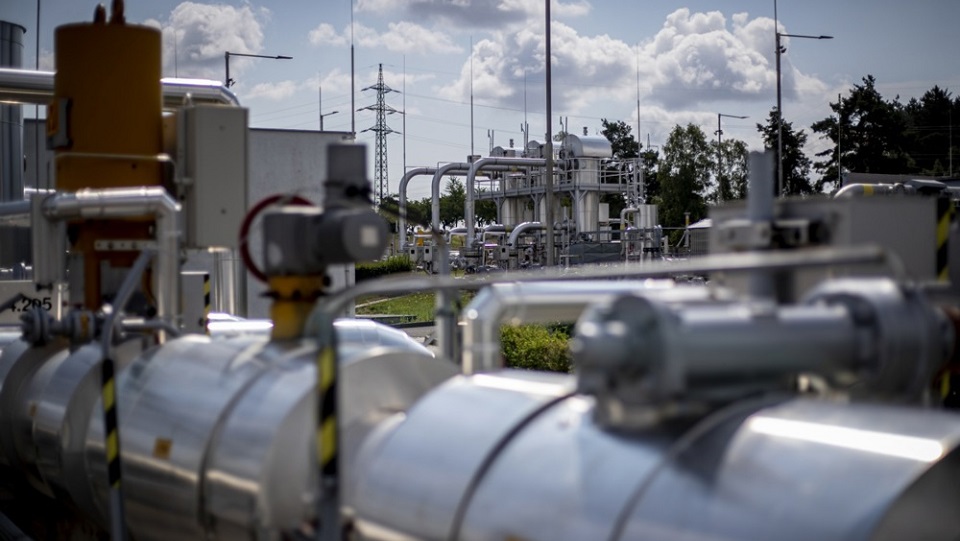
Winter 2024–2025 left European gas storage facilities at 34% — within the norm for the post-Russian aggression era, but sharply below 57% a year ago. Now the EU Agency for the Coordination of Energy Regulators (ACER) states: returning to the target of 90% by November 2025 is unrealistic.
Where did the 10% gap come from
According to ACER estimates, under current market conditions the EU will be able to fill storage facilities to approximately 80% — and this is the officially permissible minimum prescribed in EU regulations in case of difficult market situations. But even such a scenario requires, according to ACER's calculations, increasing LNG imports by 20% compared to summer 2024.
A parallel report by ENTSOG — the network of gas transmission system operators — paints an even less optimistic picture: without reducing demand by approximately 12 billion cubic meters, storage facilities risk finishing in autumn at only 78%.
"Storage filling this summer will occur at elevated prices and will remain vulnerable to sudden market disruptions"
— ACER, April 2025
Why LNG is not a savior, but an additional variable
The cessation of Russian gas transit through Ukraine from January 2025 removed one of the key sources of supply from the market. According to IEA data, Russian pipeline supplies to the EU fell by 45% (or 6.5 billion cubic meters) in the first half of 2025 compared to a year earlier. LNG was supposed to compensate for the deficit — and partially does: imports rose to a record 92 billion cubic meters for the first half, 25% more than last year.
But the global LNG market is not a tap that can be turned on to full capacity. Competition between Asia and Europe for available tankers keeps prices under pressure. The TTF benchmark at the beginning of 2025 rose to €47/MWh — twice higher than pre-crisis levels. For an ordinary household, this means heating bills that have not returned to "normal".
The situation is further complicated by the Middle East: according to ACER, if Qatar remains off the market until the end of 2026, the global LNG deficit could reach 26 billion cubic meters, and Europe would need an additional up to 56 billion cubic meters of spot purchases.
Where is the biggest gap
The largest injection volumes this summer are needed by Germany, the Netherlands, Italy, and France — it is here that storage facilities are most depleted. These same countries are the largest gas consumers in the European Union, and any shortage will affect industry and utilities most of all.
As Elena Marques, an energy poverty economist at the European Energy Poverty Observatory, noted: vulnerability is determined not by absolute price, but by purchasing power — and in this sense, the increase in wholesale prices hits disproportionately hard on low-income households.
Rules have already been rewritten to match reality
In September 2025, the EU lowered the mandatory minimum for storage filling at the beginning of winter to 75% — in other words, the norm was de facto adjusted to what was achieved. Three of the five largest gas-consuming countries in the bloc failed to meet this threshold.
This is not a catastrophe — but it is not the norm either. The safety margin that was expected after 2022 is becoming thinner. If winter 2025–2026 turns out to be cold, and one of the major LNG suppliers drops out of the game even for a month, the difference between 80% and 90% could become the difference between an expensive but manageable heating season — and another regime of emergency austerity.
The question is not whether there will be enough gas at all. The question is at what price and at whose cost Europe will get through this winter — if the global LNG market remains as tight as it is today.







