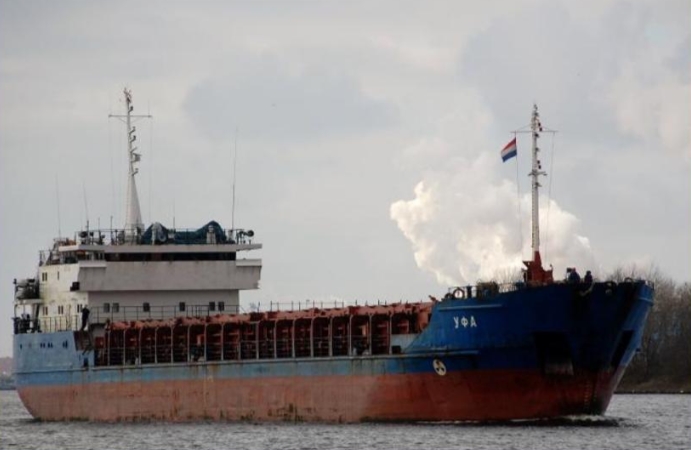
On June 4, 2026, a Swedish court approved the arrest of the dry cargo vessel Caffa. This is the first case in which a foreign court has granted a request from the Office of the Prosecutor General of Ukraine within the investigation of illegal removal of resources from temporarily occupied territories of Ukraine.
The scheme: change the flag — keep the route
According to the investigation, Caffa systematically visited temporarily occupied territories of Ukraine, violating established entry and exit procedures. To conceal its activities, the vessel used false registration: in international databases it was listed as "Guinea False" — under the Guinean flag, although, as confirmed by Swedish Minister of Civil Defense Carl-Oscar Bolin, in summer 2025 the ship replaced the Russian flag with a Guinean one.
A specific incident documented by the Main Intelligence Directorate of Ukraine's Ministry of Defense: in July 2025, Caffa loaded grain in occupied Sevastopol, then delivered the cargo to the Russian-controlled port of Tartus in Syria. The ownership structure of the vessel remains hidden.
"No manipulation of flags, routes, or registration will help avoid accountability."
Ruslan Kravchenko, Prosecutor General of Ukraine
From request to arrest — less than three months
On March 6, 2026, Sweden's Coast Guard stopped Caffa in the Baltic Sea near Trelleborg — the vessel was en route from Morocco to St. Petersburg with a grain cargo. As early as March 12, the Office of the Prosecutor General sent a request to Sweden's Ministry of Justice for international legal assistance with three specific requirements:
- conduct a search of the vessel;
- interrogate the captain and crew members;
- place an arrest on Caffa.
According to Kravchenko, the Swedish side began executing the request already the following week after receiving it: they conducted a search and interrogations. On April 11, Swedish police determined that the vessel would remain under arrest until the completion of court proceedings. On June 4, the court officially approved the arrest.
The captain of the vessel — a Russian citizen — was detained but released on bail before the court decision. In parallel, Sweden's National Operational Police Unit is conducting its own investigation into the vessel itself.
Sanctions were in place — the effect came later
Ukraine imposed sanctions against Caffa as early as November 25, 2025 — seven months after the documented voyage from Sevastopol. The vessel continued to operate until the moment of physical interception. Hakan Larsson, prosecutor at Sweden's State Bureau for Investigation of International and Organized Crime, explained the decision to confiscate the vessel by saying that the court should consider the possibility of transferring the ship to another state.
Maryana Haiovska-Kovbasiuk, spokesperson for the Office of the Prosecutor General, stated that the prosecutor's office is currently awaiting the full text of the court decision — it will determine the legal basis for the next steps, including the possible transfer of Caffa to Ukraine.
If Sweden transfers the vessel to Ukraine, it will become the first precedent of returning an asset involved in a scheme to plunder occupied territories — but only provided that the text of the decision contains an appropriate transfer mechanism, not just confirmation of the arrest.





