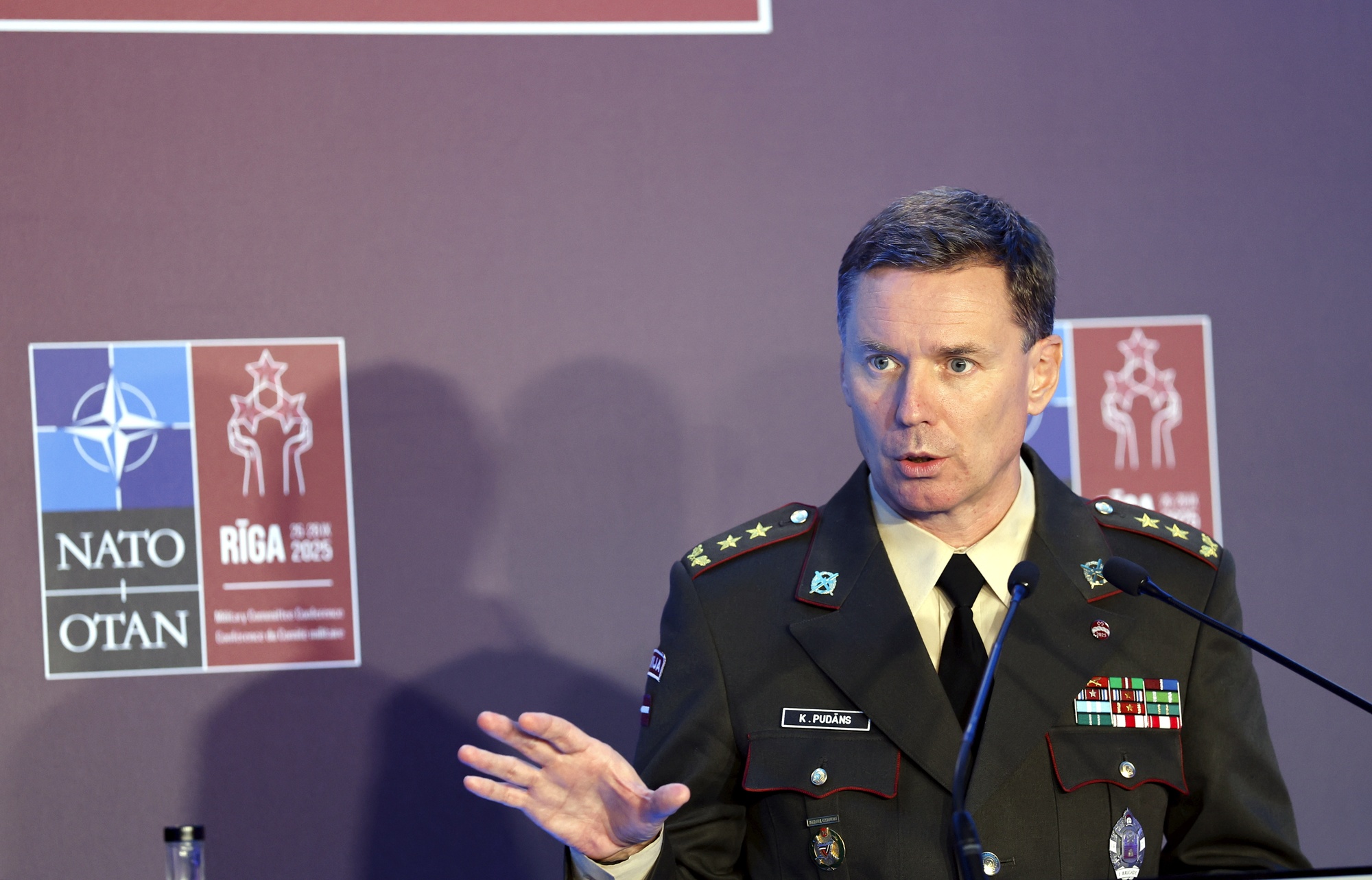
Brigadier General Kaspars Pudans, commander of the Armed Forces of Latvia, gave an interview to Financial Times in June 2026 and spoke at the Kyiv Security Forum with the same message: Russia has accumulated an advantage that it could exploit by the end of 2028. But this advantage is not technological. It is quantitative.
Not better drones, but more drones
Pudans clearly distinguishes between two types of advantage. NATO is developing more sophisticated unmanned systems. But Russia is already producing them on an industrial scale: 1.4 million drones in 2024, with plans for 2026 of 7.3 million FPV drones and 7.8 million warheads for various types of UAVs, according to Bloomberg. In April 2025, Putin called even 1.5 million per year "insufficient."
"Their advantage is in scalability. They are able to quickly replenish supplies and maintain large quantities of units."
Kaspars Pudans, Financial Times
This is precisely why the general formulates the Kremlin's logic in the first person:
"If I were in the Kremlin, I would say: if we do anything at all — we must do it by the end of 2028."
Kaspars Pudans, Financial Times
Why 2028 and not later
The answer lies in NATO's rearmament calendar. According to Pudans, most major modernization programs of European armies will begin to have real combat effect no earlier than 2029. This is the "window of opportunity": Russia is maximally armed, the Alliance is still in the process.
Berlin shares this concern. Germany's Defence Minister Boris Pistorius warned earlier that Russia could be ready to attack NATO as early as 2028–2029 and called for accelerating military buildup.
Latvia is responding concretely: in 2026, the country's defence budget reached 4.73% of GDP — €2.16 billion, and is moving toward the legislatively fixed 5%. For comparison: in 2024, this figure was only 3.3%. However, Māris Ančāns, director of the Centre for Geopolitical Studies at Riga Stradiņš University, warns that reaching 5% is not easy — part of the additional funds is planned to be obtained only from 2029 onwards through public sector reform.
Money consumed by the war itself
There is a paradox: Russia is financing the "window of opportunity" at the cost of its own economic stability. Alexander Kokcharov, Bloomberg Economics' geoeconomic analyst for Russia and Eastern Europe, explained to Newsweek that the continuation of record military spending in 2026–2028 indicates that Moscow is not preparing for peace — "rather for further fighting."
According to Financial Times, Russia's budget deficit in the first four months of 2026 already reached 5.9 trillion rubles (~$82 billion) — the largest since the full-scale invasion began. The Finance Ministry estimates that by 2028, the budget gap could widen to 4 trillion rubles in a negative scenario. The arms race that opens the "window" simultaneously undermines the economy that finances that window.
The defence line of the Baltic passes through Ukraine
Pudans said directly in Kyiv: "Our defence line — of Latvia and the Baltic states — passes through Ukraine." Therefore, Latvia is investing in technology transfer, not just equipment: the priority is to learn from the Armed Forces of Ukraine the tactics of drone deployment in real combat conditions.
Meanwhile, the Kremlin's bet, according to Pudans's analysis, is not necessarily a full-scale invasion. Testing Alliance unity through hybrid provocations "under the guise of protecting Russians" could prove more effective and cheaper — especially if the United States continues to reduce its military presence in Europe.
If NATO's rearmament programs truly become fully operational after 2029, while Russia simultaneously approaches its budgetary limit — the question is not whether there is a "window." The question is whether the Alliance will manage to close it before Moscow decides that the risk is acceptable.





