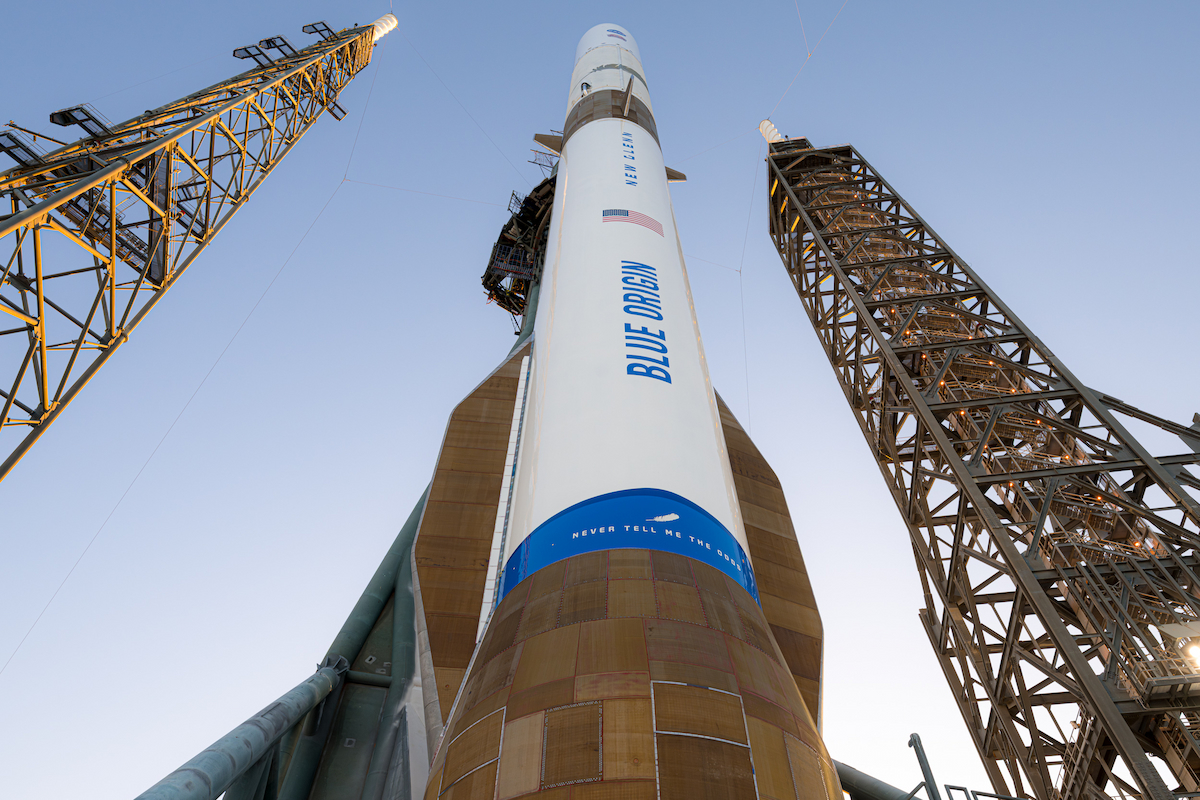
On April 19, 2026, Jeff Bezos's Blue Origin for the first time in history relaunched the New Glenn rocket — and simultaneously failed its primary mission for the first time. The first stage "Never Tell Me the Odds" successfully returned to a floating platform in the Atlantic. The upper stage placed the satellite in the wrong orbit.
What Went Wrong
The BlueBird 7 communications satellite, developed by Texas-based AST SpaceMobile, was supposed to reach a circular orbit of 460 × 460 km with an inclination of 49.4°. Instead, according to astrophysicist Jonathan McDowell, citing U.S. Space Force tracking data, the satellite entered an orbit of 154 × 494 km with an inclination of 36.1° — wrong in both altitude and plane.
"BlueBird 7 was placed into a lower orbit than planned by the launch vehicle's upper stage. Although the satellite separated and established contact, the altitude is too low to sustain operations using its onboard propulsion system."
— AST SpaceMobile, official statement
The satellite's own engines are insufficient to raise the orbit to operational altitude. The satellite will have to be deorbited — it will burn up in the dense layers of the atmosphere.
Whose Money and What's Next
BlueBird 7 is insured for 30 million dollars — the amount AST SpaceMobile expects to receive from its insurance policy. Blue Origin, meanwhile, announced that it is "evaluating the anomaly": the cause of the upper stage failure has not been officially named, and the investigation is ongoing.
The loss is painful for AST SpaceMobile in context: the company is building a direct-to-smartphone communications constellation and expects to have approximately 45 satellites in orbit by the end of 2026 at a launch cadence of once every one to two months. BlueBird 7 was supposed to be the second Block 2 generation satellite — ten times more powerful than the previous generation in terms of bandwidth. A replacement, according to the company, will be ready for the next launch.
Context for Blue Origin
New Glenn debuted in January 2025: reached orbit, booster didn't land. Second launch — orbit achieved, landing achieved. Third launch — booster landed again, but the mission failed. Industry analysts note: SpaceX won the market not only with first-stage recovery, but also with upper-stage reliability. Blue Origin has so far proven only the first part.
Blue Origin CEO Dave Limp noted before the launch that all seven engines on the upgraded booster had been replaced and several improvements had been tested. The irony: the very component that wasn't publicly updated is what failed.
If Blue Origin doesn't establish the cause of the upper stage failure before the next commercial launch — the queue of clients that the company is actively building up under its ambitious 2026 schedule will have grounds to reconsider contracts in favor of carriers with proven reliability statistics.