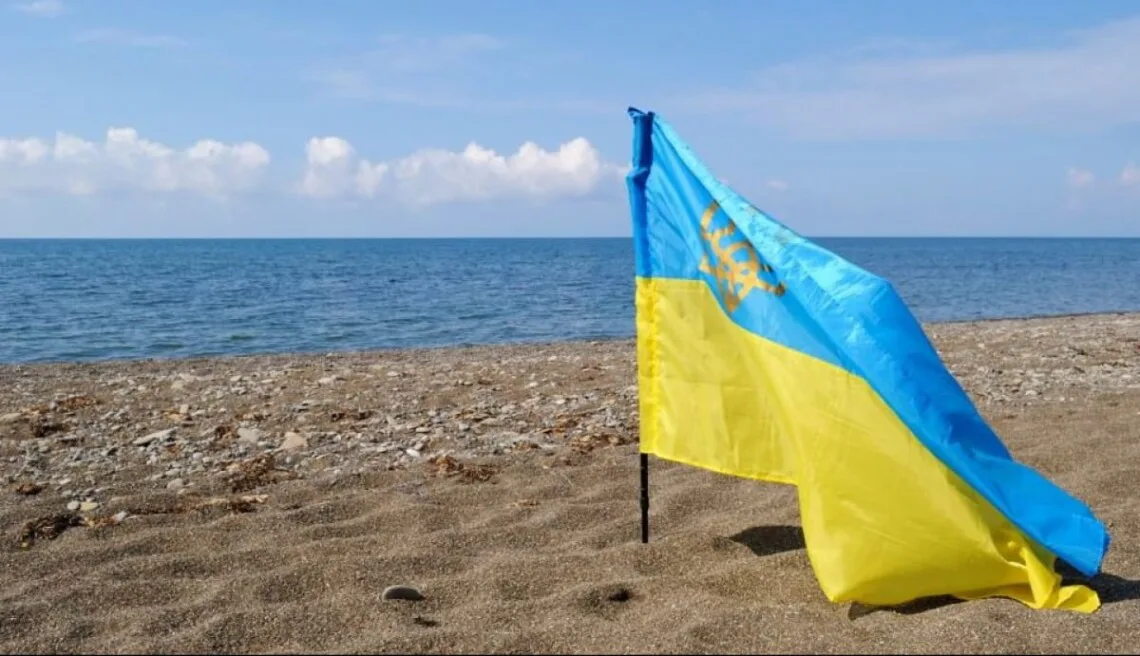
The liberation of Crimea still sounds like a strategic abstraction to most analysts. But military expert Oleksandr Kovalenko formulates a more concrete thesis: the question is not whether it is possible, but what sequence of events makes it real.
According to him, Crimea cannot be deoccupied without taking Kherson and Zaporizhzhia regions. This is not merely geography — it is the logic of supply. The Russian grouping on the peninsula depends on several key corridors: the Kerch Bridge, the road through Melitopol, crossings over the Dnipro River. Each one is a point of vulnerability.
Why August-September
Kovalenko points to the systemic effect of strikes on logistical infrastructure. If pressure on supply routes is maintained or increased, the Russian grouping in the south could find itself in a situation where troop rotation, ammunition, and equipment arrive with critical delays. August-September is not a magical date, but a calculated horizon for the accumulation of shortages.
Here is an important nuance: "critical situation" does not mean automatic collapse. It means a higher cost of holding positions and lower potential for offensive operations. For Ukraine — a window of pressure, not a guarantee of breakthrough.
Kherson Region as the Key
The left bank of the Dnipro River remains under Russian control, and from there the land corridor to Crimea extends. Without a change in the situation there, any deoccupation scenario for the peninsula requires either an air-sea operation — extremely complex logistically — or prolonged exhaustion of the enemy to the point of inability to hold the front.
Zaporizhzhia completes the picture from the other side: control over Melitopol would effectively mean cutting off the land corridor between Russia and Crimea, which would change the entire operational context in the south.
What Lies Behind the Optimism
Kovalenko's assessments fit into a broader discussion about how much strikes on infrastructure — bridges, depots, junction points — convert into operational results on the ground. Critics of this approach note that Russia has demonstrated the ability to adapt logistics even under pressure, though with losses in efficiency.
The real conflict here is not between "optimists" and "pessimists" — but between those who believe exhaustion is a sufficient condition for changing the situation, and those who insist: without ground advances in Kherson or Zaporizhzhia regions, pressure on Crimea's logistics will remain asymmetrical, but not decisive.
If August-September truly becomes a critical window for the Russian grouping — does Ukraine have enough resources and positions to exploit this pressure before the enemy adapts again?







