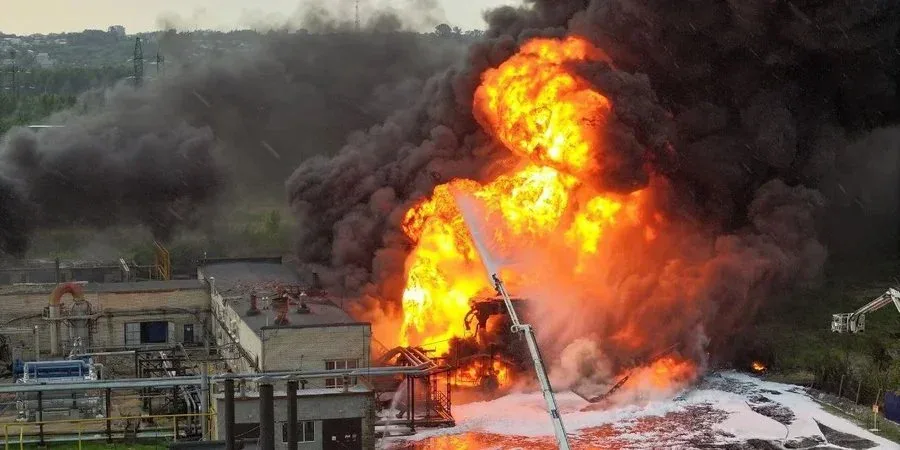
Andriy Zakrevsky, Deputy Director of the Association of Energy and Natural Resources of Ukraine, argues that strikes on Russian oil refineries are no longer simply causing one-time damage — they are creating a systemic crisis in Russia's fuel market. The situation on the ground confirms this.
From Krasnodar to Mariupol — rationing begins
The massive shortage of gasoline and diesel fuel, which initially affected occupied Crimea, has rapidly spread to Krasnodar Krai and Rostov Oblast. Many gas stations in Kuban and Rostov region have run out of A-92 and A-95 gasoline grades, as well as diesel. In occupied Mariupol, fuel is distributed only through rationing coupons, and kilometer-long queues are already forming. The Sevastopol occupation administration has temporarily suspended issuing coupons — fuel tankers simply cannot pass through damaged logistics routes.
«There are strikes on transport logistics, destruction of trucks and fuel tankers. On the transport artery leading from Rostov to temporarily occupied Crimea, almost 60–70 percent of the flow is being destroyed»
Pavlo Narozhnyi, military expert, Radio NV
Independent analyst Boris Aronshtein characterized the situation as «the sharpest crisis in recent years,» noting that the scale, coordination, and repetition of drone waves deprive Russia of the ability to respond quickly.
How much capacity has already been lost
According to BISI (Bloomsbury Intelligence and Security Institute), approximately 20% of Russia's oil refining capacity has been disabled — at least temporarily — as a result of strikes, the number of which increased 48% in 2025 compared to all of 2024. According to analysts at Energy Intelligence, Russia has lost nearly a third of its oil refining capacity. In response, Moscow banned the export of gasoline and aviation fuel.
A joint investigation by RFE/RL, Frontelligence Insight, and a volunteer group estimates direct damage from strikes on oil refineries and fuel storage facilities at at least 60 billion rubles (approximately $714 million). Taking into account the damaged gas processing plant in Astrakhan, the figure could reach $927 million.
Military industry is not spared
Strikes affect more than just gas stations. The petrochemical complex in Novokuibyshevsk (Samara Oblast) — a key supplier of chemical raw materials for the production of explosive components — was attacked twice: first in October 2025, when drones disabled primary processing equipment, and then again. Such facilities are part of an integrated fuel-chemical chain that serves both the civilian economy and military industry, Euromaidan Press notes.
According to Craig Kennedy from Harvard University, Ukraine is gradually shifting its focus — from strikes on large oil refineries to attacks on local fuel supply networks. This has a more tangible impact directly on the occupiers' front-line logistics.
Budget and time limits
In the seven months of 2025, Russia's oil and gas budget revenues declined by nearly a fifth — to $69.2 billion, with July revenues falling by more than a quarter. Oil and gas account for approximately 30% of the federal budget, so strikes on refineries also hit the financing of the war itself. Independent analyst George Voloshin warns that if Ukraine maintains the current pace of strikes, temporary factory shutdowns could escalate into systemic loss of refining capacity.
Russian analysts predict that due to damage to logistics hubs, the Kremlin is unable to quickly redirect fuel flows between regions. Russian media has already reported information about possible fuel imports from Belarus — a signal that domestic resources are insufficient to stabilize the situation.
A critical question remains unanswered: if Ukraine maintains its pace of strikes on oil refineries and fuel logistics through the end of 2025, will Russia have time to build alternative supply chains before front-line units experience a real shortage of fuel? The answer to this question will determine whether the fuel crisis becomes a tactical inconvenience — or an operational constraint for the Russian army.








