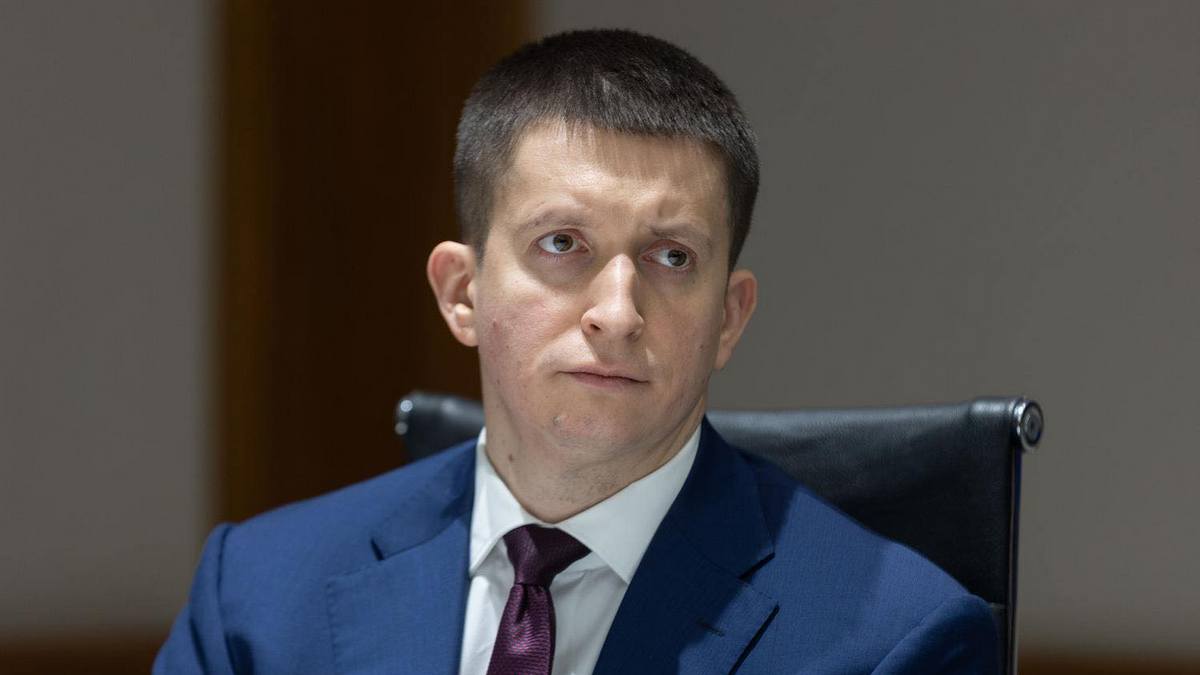
Of the 13 candidates competing for the position of head of the Agency for Search and Management of Assets, only one — Viktor Dubovik, head of the legal policy directorate at the Office of the President — made it to the final interview. On April 16, the commission failed a vote. Now Dubovik publicly claims that his status is "undefined" — and he is right formally, but not substantively.
How the sole candidate was blocked
According to the law, a decision of the selection commission is considered adopted if at least four members voted for it — and at least two of them must be from international partners. The commission voted twice on Dubovik's candidacy — both times four members voted "for" and two voted "against." This proved insufficient: those who voted against were Kateryna Ryzhenko, deputy executive director of Transparency International Ukraine, and Rita Simoes, an asset recovery specialist at the Basel Institute on Governance, and their votes proved decisive.
The grounds were questions about the candidate's financial status. According to Simoes, Dubovik's explanations regarding the sources of his assets amounted to claims that are difficult to verify independently — and this is insufficient for a position at this level. Ryzhenko noted that the candidate provided many explanations, but where documentary confirmation was lacking, it remained only to rely on his word.
"Integrity is not only the absence of wrongdoing, but also confidence that a person will withstand public scrutiny in the future."
Rita Simoes, member of the selection commission, Basel Institute on Governance
What exactly raised concerns
During the interview, the commission focused on Dubovik's financial history. According to the commission chair's calculations, the total amount of financial assistance from his ex-wife's parents for purchasing various property items exceeded $200,000 — the candidate confirmed this figure, noting that the actual amount was larger. The commission separately drew attention to an asymmetry in the divorce settlement: Dubovik received property in territory controlled by Ukraine, while his ex-wife received mostly property in occupied or front-line regions.
In the practical assignment, Dubovik scored 21 out of 50 points for the legal section and 9 out of 40 for the economic section — a result that is not in itself grounds for rejection, but adds context to the "superficiality" of answers noted by the international commission members.
A legal trap with no way out
The most unexpected turn — is not in the voting failure itself, but in what happens next. The commission noted that this situation is not directly regulated by the ARMA law, and therefore makes it impossible to make a decision on the candidate's compliance with the requirements for the head of the agency — and the commission also cannot submit the candidacy to the Cabinet of Ministers.
The commission announced the end of the meeting, promising to return to the question of further steps later. Dubovik responded by writing on Facebook that he considers his status "undefined" and hopes for a review.
- Appoint him is impossible — there is no quorum from the international members.
- Officially reject — there is also no legal mechanism for that.
- Announce a new competition — it is unclear on what grounds, if the previous one is formally not completed.
Recall: in June 2025, the Verkhovna Rada passed a law on restarting ARMA with a new leadership selection procedure, and the former head Olena Duma was dismissed on July 30 at her own request. Since then, the agency, which manages thousands of seized assets, has been operating without a permanent head.
If the commission decides to announce a new competition — Dubovik will likely challenge that decision in court. If lawmakers fail to fill the gap in the ARMA law with a separate provision, each subsequent competition risks falling into the same trap: international members have the right of veto, but the law does not say what to do when they use it.







