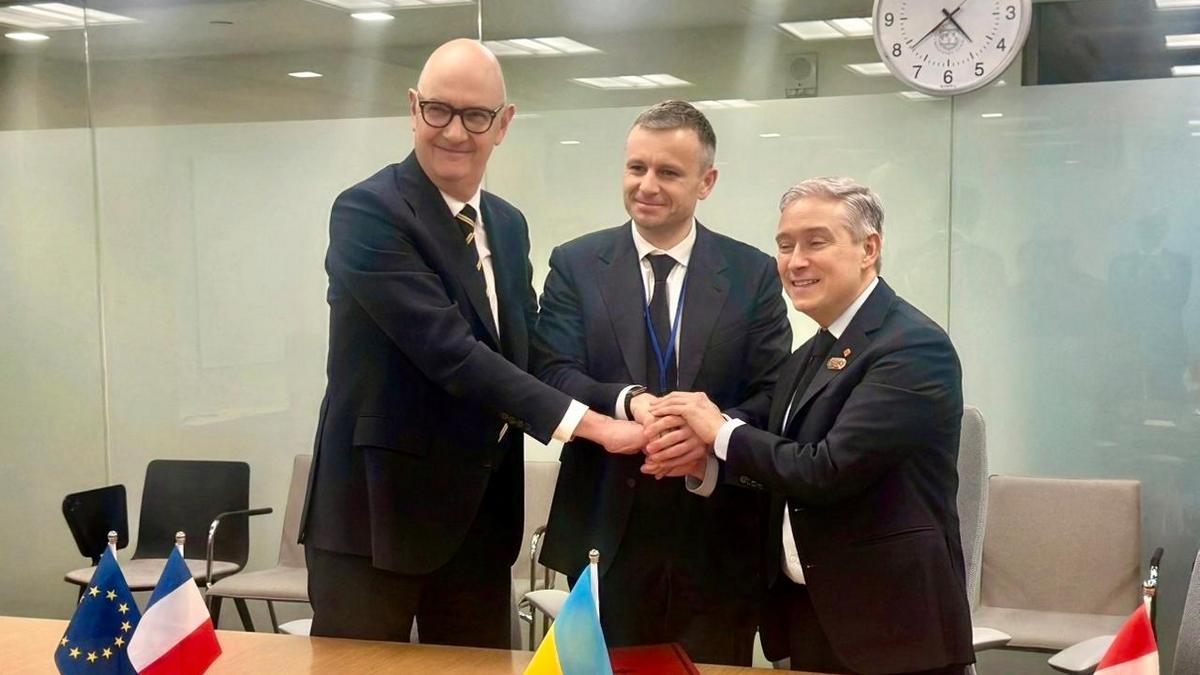
Finance Minister Sergiy Marchenko signed an updated memorandum on the suspension of payments on state and state-guaranteed debt with representatives of nine countries — Canada, France, Germany, Japan, Italy, the Netherlands, the United Kingdom, the United States, and the Republic of Korea. The document renews the moratorium that has been in effect since September 2022 and extends it until the end of February 2030.
What exactly was signed
The new agreement covers debts that were supposed to be serviced from February 2026. Additionally, the moratorium extends to loans provided after July 2022 and until November 26, 2025 — the date when the IMF and Ukraine concluded a staff-level agreement on a new EFF program.
"This voluntary suspension of debt payments is part of an international support package of $122 billion provided by Ukraine's partners."
— Sergiy Marchenko, Finance Minister
The timelines are synchronized with the new four-year IMF program of $8.1 billion, which the Fund's Executive Board approved in February 2026. The program is designed through 2030 and provides for a total international support package of $136.5 billion.
Implementation mechanism: a two-stage approach
The key aspect of the document — not the amount or the timeline, but the architecture. Creditors clearly chose a phased approach:
- First stage — the existing moratorium continues for the entire period of the IMF program. No payments are made; debt accumulates.
- Second stage — "final settlement" of the debt is postponed until what creditors officially called exceptionally high uncertainty — that is, the duration and consequences of the war — disappears.
In other words: the signed document does not fix debt forgiveness or a repayment schedule — it fixes a pause with an open-ended conclusion regarding final terms.
What is required in return
The creditor group in its statement published by the French Ministry of Finance directly stated the conditions for continuing support. Ukraine must:
- increase its own budget revenues and reduce dependence on external transfers;
- advance structural reforms — rule of law, anti-corruption measures, economic formalization;
- fulfill the conditions of the IMF program, including fiscal consolidation.
Creditors separately called on other official bilateral and commercial creditors to "reach an agreement with Ukraine as soon as possible on no less favorable terms" — a reference to China and private holders of Eurobonds, with whom negotiations are ongoing separately.
Context: debt grows, IMF warns
According to the Finance Ministry, Ukraine's total government debt exceeded $136 billion. The IMF projected that without appropriate measures, the ratio of government debt to GDP could reach 137% in 2027 — with a sustainability threshold of approximately 68% of GDP. The moratorium allows Ukraine to avoid servicing official bilateral debt and direct these funds to defense and social spending.
In parallel, Ukraine completed the restructuring of $20.5 billion in Eurobonds in 2024–2025 and reached an agreement with China's Export-Import Bank on deferring a $850 million loan until 2034–2040. Unresolved remain Ukrenergo Eurobonds of $825 million and a commercial Cargill loan of $0.7 billion.
If the new IMF program is fully implemented and by February 2030 sufficient clarity emerges regarding the end of the war — creditors are to begin negotiations on final debt settlement under new, peacetime parameters. But if "exceptionally high uncertainty" persists — the second stage conditions will be renegotiated again.