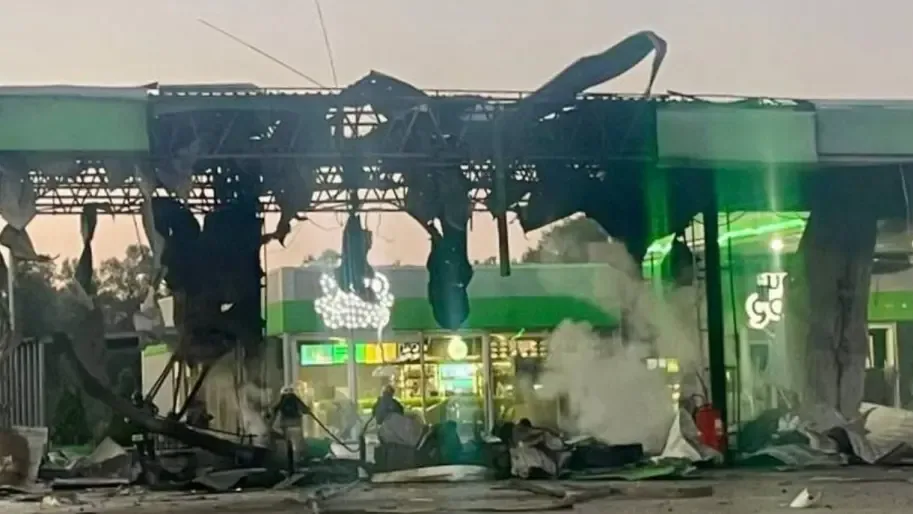
A gas station is a place where a person spends only a few minutes, which is why safety is rarely a concern there. This is precisely what the Kyiv Regional Military Administration is trying to change: the head of the RMA, Timur Tkachenko, announced a decision to strengthen the protection of gas stations in the region — from automatic alarm notifications to clearing access roads for emergency vehicles.
Our common task is to strengthen the safety of employees and visitors at gas stations in Kyiv region, given the challenges posed by the war
— Tkachenko stated.
The problem is not the alarm itself, but the response to it
The main practical issue is not the siren itself, but the fact that gas station personnel often lack a clear action plan when it sounds. Now gas stations want to implement automated alert systems and response protocols — that is, written instructions on who cuts off fuel supply, who directs people, and exactly where to go.
This is the difference between "hearing a siren" and "knowing what to do in 30 seconds" — at a gas station where fuel tankers are nearby, this difference is critical.
An unexpected barrier — abandoned cars
The second set of measures concerns something that is usually not considered in the context of safety: vehicles abandoned on gas station territory. According to Tkachenko, they clutter evacuation routes, block access to fire hydrants, and prevent fire and rescue vehicles from passing through.
The next issue is clearing gas stations of abandoned vehicles that clutter evacuation routes, obstruct access to hydrants, and prevent emergency vehicles from passing. We will present specific solutions to these issues at the next meeting of the Kyiv Region Defense Council
— Tkachenko emphasized.
This is not just about the consequences of drone or missile attacks, but about basic logistics: if an ambulance or fire truck cannot approach, the consequences of any incident — not just military ones — become worse.
Shelters where they physically don't exist
The third point is the most resource-intensive: equipping shelters near gas stations located far from existing protective structures. In practice, this means that some gas stations in the region currently operate without adequate shelter within walking distance, and decisions about the construction or designation of such facilities are planned to be made at the next meeting of the Kyiv Region Defense Council.
Drone attacks on fuel infrastructure are no longer rare: recently, unmanned aircraft struck a gas station and an enterprise in the Poltava district. This makes the issue not hypothetical, but practical for everyone who stops to refuel daily.
If concrete decisions on shelters and territory clearing are made soon, this will be a test: whether the region can turn intentions into real infrastructure faster than will be needed during the next alarm.