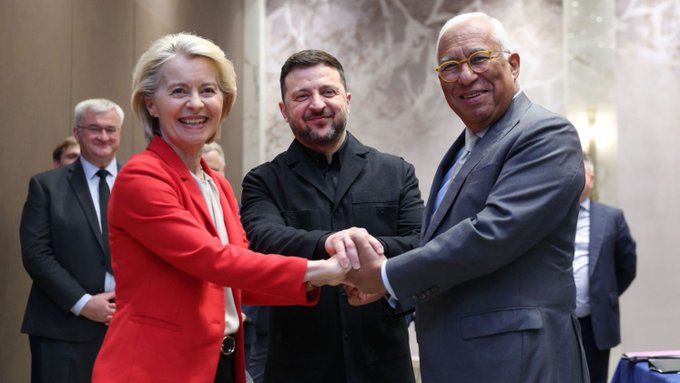
On April 23 in Lefkosia, Ukrainian President Volodymyr Zelenskyy, European Council President António Costa, and European Commission President Ursula von der Leyen signed a joint statement following a three-way meeting — on the eve of an informal summit of EU leaders. Three key points: a credit facility, sanctions, and accession. Each requires clarification.
€90 billion: The money exists, but not for everyone
The €90 billion credit facility to support Ukraine in 2026–2027 was officially approved by the EU Council that same day. The Czech Republic, Hungary, and Slovakia withdrew from the agreement — the package passed through the "enhanced cooperation" mechanism, which allows action without unanimity. This sets a precedent: essentially part of the union is financing Ukraine outside a joint decision.
"The credit will ensure that Ukraine can meet its urgent budgetary and defense needs, enabling the country to remain resilient in the face of ongoing Russian attacks."
From the joint statement by Zelenskyy, Costa, and von der Leyen, April 23
The European Commission expects to disburse the first tranche "as soon as possible in the second quarter of 2026" — but spokesperson Balazs Ujvari clarified that he cannot guarantee specific deadlines: negotiations over the credit agreement and reform plan are ongoing. The €90 billion will cover approximately two-thirds of Ukraine's estimated needs for this period.
Accession: Six clusters, one requirement — unanimity
Leaders "called for the immediate opening of negotiating clusters" — but the mechanism for this opening requires a unanimous decision of all 27 EU member states in the EU Council. The European Commission has already determined that Ukraine has met conditions for opening clusters 1 (accession criteria), 2 (internal market), and 6 (external relations). Work is ongoing on the other three.
Expansion Commissioner Marta Kos had previously warned that the process depended on the formation of a new government in Hungary — the only country capable of blocking a decision unanimously. She had hoped to open all six clusters by the end of 2025, but this did not happen. The current goal is to close negotiations by the end of 2028, which the European Commission considers realistic only if reforms are accelerated, particularly in the rule of law sphere.
- Cluster 1 — "Accession criteria" (rule of law, democratic institutions, public administration) — opens first and closes last
- Clusters 2 and 6 — ready for opening according to the European Commission's assessment
- Clusters 3, 4, 5 — conditions not yet met
Sanctions and children
That same day, the 20th sanctions package against Russia came into force. According to the three leaders, it is "aimed at reducing Russia's energy revenues, restricting its banking system, and shadow fleet operations." Separately, a high-level meeting of the International Coalition for the Return of Deported Ukrainian Children was announced — May 11 in Brussels, jointly by the EU, Ukraine, and Canada.
According to his press service, Zelenskyy also held separate meetings in Cyprus with Lithuanian President Gitanas Nausėda and Danish Prime Minister Mette Frederiksen. The main pressure point before the visit, according to Zelenskyy himself, was the question of Russian oil transit through the Druzhba pipeline — a condition he rejected and which, in his view, was holding up both the credit facility and the sanctions.
What's next
The credit agreement has not yet been signed — the European Commission and Kyiv are conducting "bilateral consultations." The negotiating clusters are not formally opened — the statement calls for action but does not obligate the EU Council to act within specific deadlines. If the first tranche does not arrive by the end of the second quarter, and the Council still has not voted to open even cluster 1 — the question of whether Lefkosia marks a turning point or is another declaration without an enforcement mechanism will receive a clear answer.





