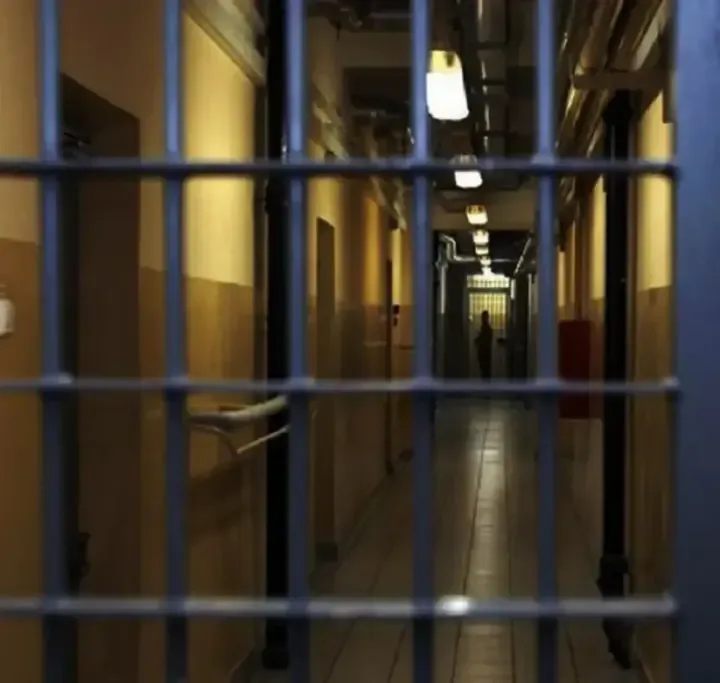
During air raids, Kyiv residents descend to metro stations or basements. Prisoners at Kyiv's pre-trial detention center (SIZO) remain where they are. The entire facility has no civil defense shelter.
The Department for the Execution of Criminal Sentences of the Ministry of Justice confirmed this in response to UNN's inquiry: building a shelter for 3,000 people — the number of people in the facility including staff — is impossible due to the complete absence of free space on the territory. Instead of shelters, people are moved during air raids to "most protected places" — load-bearing walls inside internal buildings.
What "most protected place" means in an old Soviet detention facility
Kyiv's SIZO is located in buildings constructed during the Soviet era. Load-bearing walls provide some protection from shrapnel, but not from direct hits by aerial bombs or ballistic missiles. Such a direct hit proved fatal on July 28, 2025, when Russian Armed Forces dropped four guided aerial bombs on Bilenky Correctional Colony No. 99 in Zaporizhzhia region.
"Prisoners are civilians and must be protected in accordance with international humanitarian law"
Danielle Bell, head of the UN Human Rights Monitoring Mission in Ukraine (HRMMU)
According to the UN, at least 16 prisoners were killed in that strike, with approximately 100 wounded. The mission noted that the attack may be classified as a serious violation of international humanitarian law. Zaporizhzhia Colony was located 25 kilometers from the front line — Kyiv's SIZO is in the capital, but the presence of shelters does not depend on location.
Legal obligation and practical void
Ukrainian legislation obligates penal institutions to ensure the protection of persons held within them. The problem is that the rule exists, but the mechanism for its implementation does not: neither funding for a specific facility nor an alternative solution in case of lack of space.
A similar situation is not unique to SIZO. As a 2025 survey of Kyiv shopping malls showed, some large public facilities in the capital also had no clear answer to the question of where clients should go during air raids. The difference is that a shopping mall visitor can leave and go to another shelter. A prisoner cannot.
Who bears responsibility — and to whom
The Ministry of Justice documented the problem. But recognizing a fact without a solution plan is not a work report, but a description of helplessness. Possible scenarios that the department has not publicly discussed:
- Evacuation of some prisoners to facilities outside Kyiv during escalation — legally complex, logistically feasible;
- Construction of a vertical shelter (underground level under one of the buildings) instead of horizontal expansion;
- Review of facility capacity: if there is no space even for shelters, perhaps the SIZO is overcrowded beyond safe norms.
None of these options appear in the Ministry of Justice's response. It only states: there is no space, there is nowhere to build.
If after the strike on Bilenky Colony the Ministry of Justice does not receive separate funding or a directive regarding an evacuation protocol for SIZOs without shelters — the next response to a journalist's inquiry will be identical to this one.