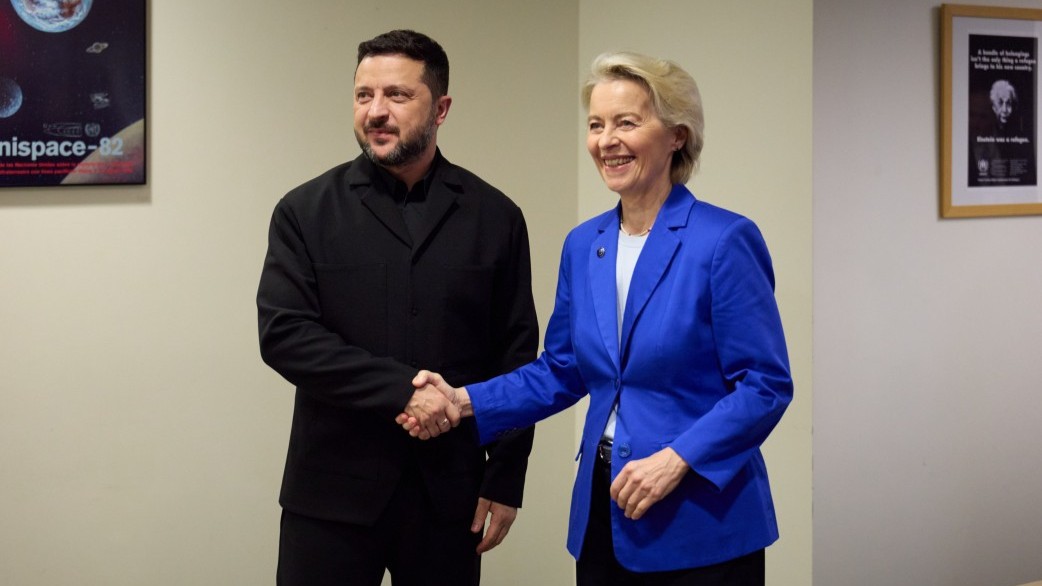
Vladimir Zelensky's conversation with Ursula von der Leyen in the corridors of the UN General Assembly was brief, but left a tangible aftertaste. Bloomberg, citing a source familiar with the details, describes the meeting in one word — "tense". Formally, the parties discussed financing for the next year. In essence, the discussion was about who should trust whom more: Kyiv trusting Brussels or vice versa.
Money in exchange for laws
European Union representatives made it clear to the Ukrainian delegation: before receiving additional funds, Kyiv must demonstrate progress in combating the shadow economy, increasing tax revenues, and bringing legislation closer to European standards. This is not a new requirement — the need for the Verkhovna Rada to adopt reforms to receive an IMF tranche has been discussed before. But this is the first time it has been voiced so harshly at the highest level, and precisely when Ukraine entered 2026 with the largest budget deficit since the start of the full-scale war.
IMF Managing Director Kristalina Georgieva, during a separate meeting with Zelensky, similarly insisted: the continuation of reforms is a condition for continuing financial assistance. The president himself publicly acknowledged the scale of the problem on September 18, calling the budget deficit "cosmic".
Why now
The timing of such pressure is not accidental. A meeting of the European Council is approaching, at which they are to decide the fate of a "reparations" loan worth tens of billions of euros from frozen Russian assets — an instrument that could theoretically cover the lion's share of Ukrainian needs for 2026. But there is no unanimity among the twenty-seven EU member states, and some governments prefer to tie new financing to clear, measurable commitments from Kyiv. The demand for progress in anti-corruption legislation is both a real concern about Ukraine's institutional capacity to spend money transparently and a convenient argument for domestic politics in capitals where support for Ukraine no longer enjoys automatic majority support.
There is also a purely accounting aspect: Brussels disagreed with some Ukrainian calculations of budget needs and proposed distributing the burden more widely — involving Canada, Norway, and Japan. For the EU, this is a way to avoid bearing sole responsibility for the financial stability of a neighboring country if the war drags on for years.
Kyiv's response
For its part, the Ukrainian side raised issues at the meeting that were equally uncomfortable for partners. First and foremost — limited stockpiles of air defense means on the eve of winter, when the intensity of Russian strikes traditionally increases. And also — the EU's decision to lift personal sanctions against two Russian oligarchs, Alisher Usmanov and Mikhail Fridman, in order to preserve consensus on continuing sanctions against Russia as a whole. Kyiv found this trade-off unjustified concession precisely at a moment when partners are being asked to show greater, not less, firmness.
The meeting between Zelensky and von der Leyen was "tense," according to a Bloomberg source familiar with the course of negotiations.
Who loses from the pause
Formally, both sides are right: Brussels has the right to demand accountability for the money of European taxpayers, and Kyiv has the right to count on speed when it comes to air defense in winter. But therein lies the conflict — the bureaucratic pace of the EU is poorly aligned with the military pace at which Ukraine lives. Every week of coordination and doubts about figures is a week when decisions about purchasing air defense missiles or patching the budget deficit are postponed.
The parties agreed to return to negotiations in the coming weeks. The question is simple: will the Verkhovna Rada manage to adopt the required anti-corruption changes and gather enough votes for laws that have been stalled for years due to domestic political reasons, before the budget deficit becomes not an accounting problem but a frontline one.