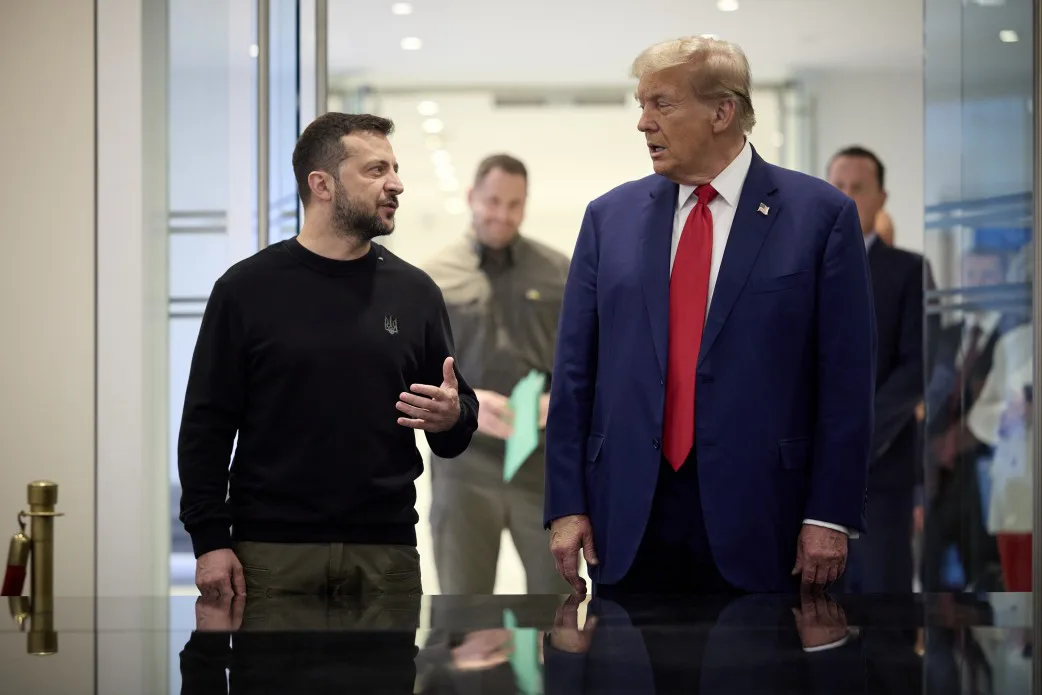
US President Donald Trump wrote on Truth Social that Russia "unfortunately lost control of its diesel industry" due to strikes on oil refineries, and called for an end to the war, which claims 25,000 lives monthly. President of Ukraine Volodymyr Zelensky responded that dialogue with Trump continues, and ideas on the table regarding steps toward peace, starting with de-escalation around energy infrastructure.
Praise and requests to stop — in one week
The same fact that Trump publicly presents as evidence of Russia's failure, he privately asks Ukraine to reduce. According to Axios, during a telephone conversation with Zelensky, the US president repeatedly asked him to stop strikes on Russian oil refineries. The reason is not concern for Russia, but fuel prices in the world: the US president links Ukrainian attacks on Russian oil refining to rising global diesel prices. According to the publication's source, a significant portion of the telephone conversation was about Ukrainian attacks on Russian refineries.
This request is not new. On September 14, Trump said he had asked Zelensky about this due to rising diesel prices, much of which comes from Russia, according to the US president. It turns out that both sides recognize the effectiveness of Ukrainian strikes — only the Ukrainian side sees them as leverage against Moscow, while Washington increasingly views them as a threat to its own fuel market.
Why now
The statement about "lost control" appeared on the eve of a personal meeting: Trump's statement came ahead of his meeting with Zelensky in New York, expected on September 22 at the UN General Assembly. The arrangement for the meeting emerged during the mentioned telephone conversation — during this same call, Zelensky and Trump agreed to meet at the UN General Assembly, and the meeting is expected to take place on Tuesday.
The very next day, Trump's rhetoric made another turn: the next day Trump wrote on Truth Social that Ukraine and Russia allegedly agreed to refrain from striking each other's energy facilities. The speed with which the public thesis changes — from "Russia lost control" to "the sides agreed not to strike energy infrastructure" — reveals more preparation of ground before the New York meeting than a fixation of fact.
Who benefits
For Trump, the connection is advantageous in two ways at once. Publicly, he shows that pressure on Russia works and that the "strength through strength" position produces results even before any negotiations on ending the war. Privately, he protects the American voter from more expensive diesel, demanding that Kyiv restrain precisely the weapon that produces this result. This is not a contradiction in the understanding of the White House — it is an attempt to get the effect without the price.
For Zelensky, the benefit is different: recognition of the effectiveness of strikes from Trump's own lips is an argument that is hard for allies to dispute, who have so far doubted the expediency of long-range attacks on Russian oil refineries. At the same time, Kyiv immediately turns this praise into a condition for any de-escalation.
Ukraine's energy sector, critical infrastructure, and our food exports must stop being targets for Russia, and this will lead to corresponding steps regarding de-escalation on our side.
Condition in response to condition
Zelensky neither refused nor agreed unconditionally — he issued a mirror demand. Zelensky in response stated that Ukraine is ready to support mutual de-escalation only on the condition that Russia truly stops attacks on Ukrainian energy infrastructure and other critical infrastructure. In other words, an exchange of strikes on refineries for limited cessation of Ukrainian generation attacks is possible only as a bilateral, not a unilateral gesture of goodwill.
This is a fundamental difference from what Trump wants: he asks for specific action now, citing fuel prices, while Zelensky ties any pause to Russia's verified behavior, not promises.
What's next
If at the September 22 meeting in New York Trump tries to turn his request about refineries into a formal part of a future agreement, Ukraine will have to publicly determine: agree to a pause to preserve Washington's support or insist that giving up the main effective lever of pressure on Russia without mirror steps from Moscow is a loss, not de-escalation. The answer will become clear from the results of this meeting.