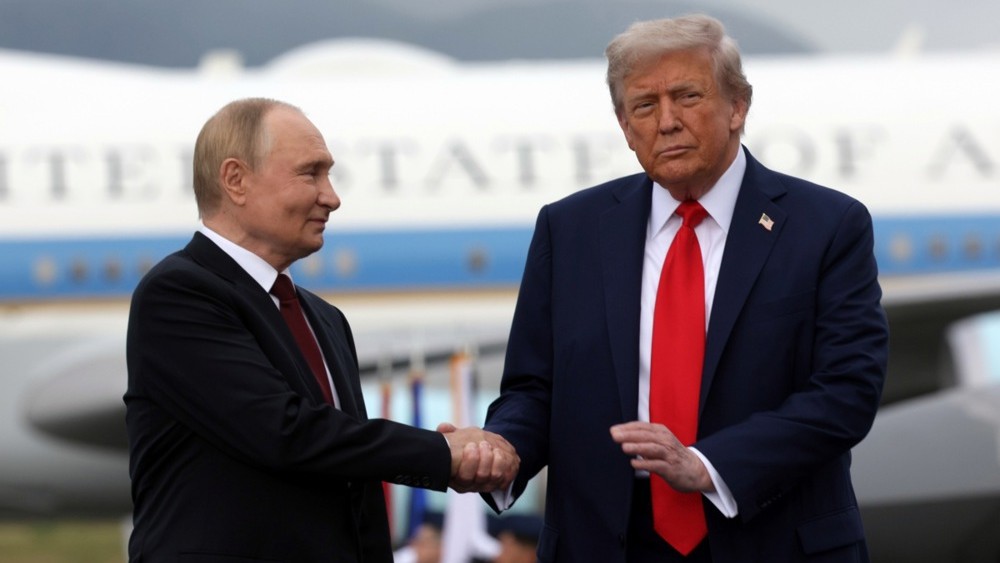
Yuri Ushakov met with journalists after Putin's meeting with Steve Witkoff and Jared Kushner and said a phrase worth reading twice: the negotiators discussed economic issues and "potentially large mutually beneficial Russian-American projects" in "considerable detail." The war continues, the Donbas is under fire, and yet talk has already turned to joint business ventures.
The New York Times, citing two American officials familiar with the course of negotiations, reports that the Trump administration is considering concluding business deals with Russia even before a peace agreement with Ukraine. The logic of one of the publication's sources is straightforward: agreements reached before the war ends should demonstrate that Washington is seriously committed to "resetting relations" with Moscow — and this very seriousness should prompt Russia's elite to pressure Putin for peace.
The Carrot Exists, but the Stick is in Question
Formally, the White House strategy looks like a classic "carrot and stick" approach. Trump signed a law imposing sanctions against Russia, designed to pressure Putin to end the war. But meanwhile, the White House leader is considering options for normalizing relations with Russia — that is, the carrot is being offered in parallel with the stick, not after it.
This is where the first crack appears between declaration and commitment. A White House representative has already publicly denied the very framework presented by the NYT, stating that business deals with Russia will not be concluded while the war in Ukraine continues. But Trump himself said something different earlier — and this very discrepancy between the administration's statements shows how much this "reset" is rather a test message for the Kremlin than an agreed-upon course.
"Economic issues and potentially large mutually beneficial Russian-American projects were discussed in considerable detail"
Implementation Mechanism: Which Doesn't Actually Exist
The NYT report contains no details whatsoever about how hypothetical deals would take legal form before the war ends: whether these would be intergovernmental memoranda, private contracts of American companies under Washington's political patronage, or simply permits to operate outside parts of the sanctions regime. The discussion covers sectors — from energy to, according to other reports, Arctic cooperation — but not timelines, deal participants, or the mechanism for their adoption.
Meanwhile, the U.S. Congress has just passed a sanctions package through both chambers featuring tariffs of up to 100% for those trading with Russia — a decision that complicates any rapid "economic thaw" regardless of what the White House wants. Republicans and Democrats in Congress are convinced that only increased economic and military pressure on the Kremlin can force Putin to end the war — and this directly contradicts the "carrot before peace" logic described by the NYT.
What the Other Side Says
The Kremlin's reaction is entirely consistent with expectations: Ushakov readily confirmed the fact of negotiations about joint projects, because for Moscow any mention of economic rapprochement with the United States is already a diplomatic victory regardless of subsequent developments. But according to the same NYT report, Putin told the American negotiators that he would capture the Donbas within several months — and Kushner disagreed with him. In other words, in one and the same meeting, there was simultaneous discussion of "mutually beneficial projects" and plans for further seizure of Ukrainian territory.
After his trip to Moscow and Kyiv, Kushner openly expressed doubt about whether Putin is ready for genuine negotiations. This is a key detail: the person who is himself conducting negotiations about possible economic deals with Russia is publicly uncertain about the other side's intentions regarding peace in general.
- Czech Prime Minister Babiš claimed that to end the war, pressure should allegedly be applied not only to Putin but also to Zelensky — rhetoric that fits into the general trend of blurring responsibility for the aggressor.
- On September 5, Witkoff and Kushner were in Moscow, and already on September 6 — for the first time in Kyiv, where they raised the topic of energy ceasefire.
What This Actually Means
For now, we have not a decision but a signal, and even this signal contradicts itself: some sources from the administration hint at deals before peace, others officially deny it, while Congress simultaneously tightens the sanctions screws. For the Kremlin, any public mention of "mutually beneficial projects" is already a tool for domestic propaganda that sanctions don't work and business with the United States is possible despite the war.
The question that remains open is: will the discussion of economic projects become a real lever capable of forcing Putin's inner circle to pressure him for peace, or will the Kremlin simply use the negotiations themselves as proof that isolation has exhausted itself — without any concessions regarding the Donbas or cessation of hostilities.







