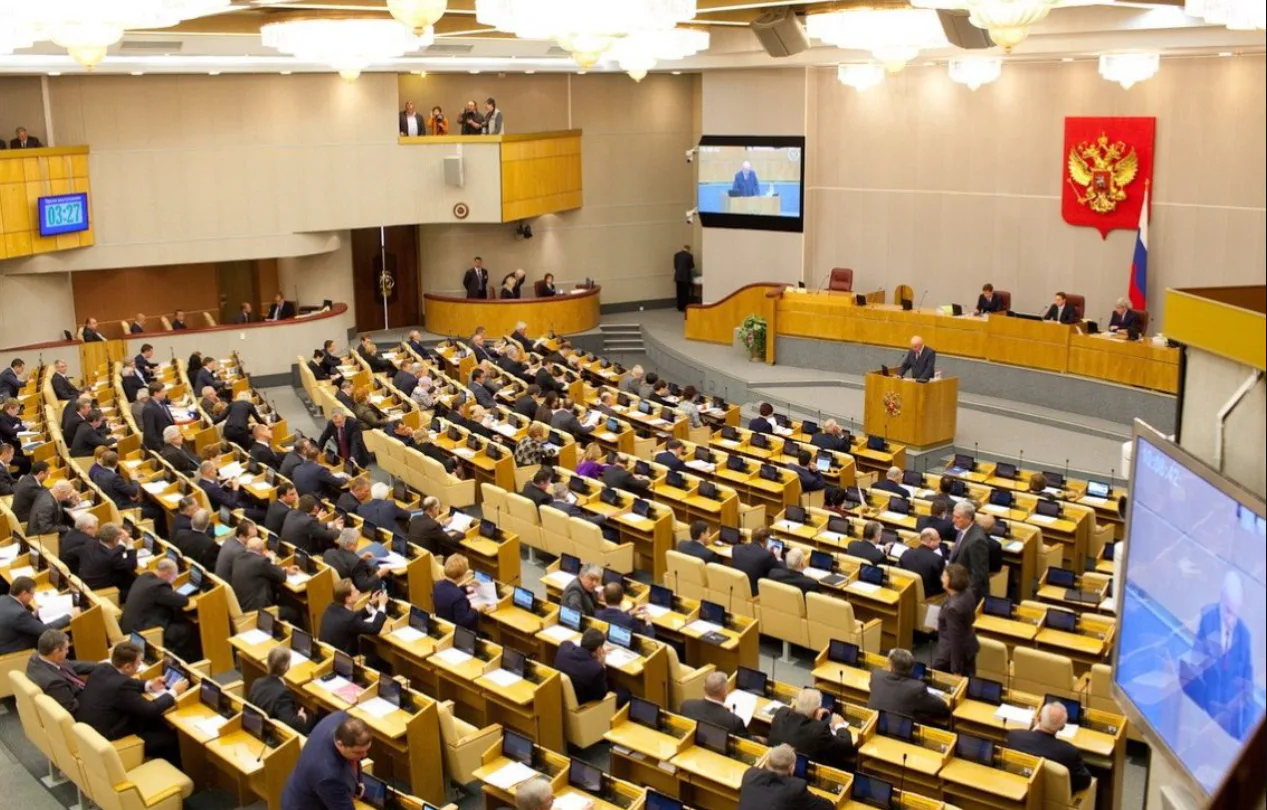
A three-week voting period from September 18–20 concluded in Russia with a predictable outcome: United Russia claims more than 300 of the 450 seats in the State Duma of the ninth convocation, and by some counts already around 340 or more seats. On the federal list, the party is gaining approximately 57–58% of the vote — nearly eight percentage points higher than five years ago, when United Russia received 49.82% and 324 mandates. Now, according to preliminary CEC data and calculations by Russian media, Putin's party is crossing the threshold of a constitutional majority with a comfortable margin.
Why Now
Formally, these are routine elections following the five-year cycle that began in 2021. But they are taking place in the third year of a full-scale war, when the Kremlin needs not merely a loyal but an unquestioningly controlled lower house. The previous composition of the State Duma already voted on legislative packages regarding mobilization resources, military budgets, and restrictions on civil rights — but it did so with the support of a coalition of factions. The new composition allows such decisions to be made by a single party alone, without needing to negotiate even with formally loyal KPRF or LDPR.
What Constitutional Majority Provides
The key difference from an ordinary parliamentary majority is that United Russia does not need votes from other factions to pass federal constitutional laws — at least two-thirds of deputies are required for this. The same number of votes is needed to override a presidential veto on a federal law, though this also requires an appropriate majority in the Federation Council.
A constitutional majority allows the faction to independently secure two-thirds of votes when reviewing amendments to chapters 3–8 of the Russian Constitution. However, the State Duma cannot unilaterally change the Constitution: such amendments require approval by three-quarters of the Federation Council and legislative bodies of at least two-thirds of the regions. That is, United Russia strengthens control over the lower house, but does not gain sole control over the entire procedure of changing the Constitution or passing federal constitutional laws — the Federation Council and regional bodies always retain a role.
Who Benefits
The most direct beneficiary is the presidential administration, which gains a parliament capable of making decisions without risk of delays or public disputes, even in the form of decorative debate. For United Russia, this is also insurance in case it becomes necessary to quickly change legislation to meet front-line needs — from new waves of mobilization measures to budget redistribution toward defense industry. The less the party depends on other factions, the fewer venues where any public disagreement could emerge during wartime.
How Opponents Respond
The formal opposition demonstrates opposite dynamics. The KPRF, which received 19.19% in 2021, now holds second place but with results of approximately 13–14% — a historical minimum for the party in recent cycles. The LDPR maintains 8.75%, while the New People party is nipping at its heels with 7.97%, claiming the status of the main "systemic" voice of discontent. The most telling story is that of A Just Russia, which for the first time may fail to overcome the five percent threshold and lose representation in the Duma entirely.
The KPRF, LDPR, and A Just Russia are entering a crisis period, risking failure to pass the electoral threshold due to global problems in positioning and branding.
This was the forecast made in 2024 by political analyst Alexei Chesnakov for these elections. His prediction was partly correct: the KPRF and LDPR retained their seats in the Duma, though with noticeable losses, while A Just Russia found itself on the brink of exiting parliament. None of these parties questioned the legitimacy of the voting results — criticism came down to individual procedural complaints rather than to the system itself.
The question is not whether United Russia will be able to continue unilaterally pushing through decisions the Kremlin needs — with such a majority, that becomes a technical detail. The question is how long the regime can maintain the appearance of multiparty politics if even the last systemic alternative in the form of A Just Russia risks disappearing from the parliamentary map already in this convocation.